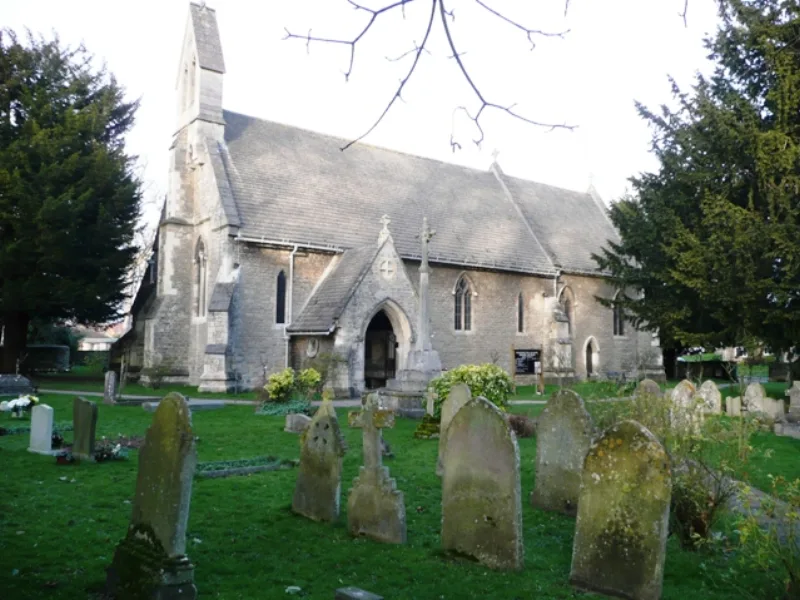
Holy Trinity, Headington Quarry
C. S. Lewis's parish church from 1930 to his death in 1963 — designed by George Gilbert Scott, built 1848 to 1849 for the quarry workers of Headington Quarry, with a 1991 Narnia window in the north aisle and the Lewis brothers buried in the churchyard.
Three things to look for in sequence: the Narnia window in the north aisle (a lamp post, the word Narnia, Glimfeather the owl, the Dawn Treader, Cair Paravel — installed in 1991, bequeathed by neighbours of the Lewis brothers in memory of their children); the Christ in Glory stained-glass window above the altar (1951, by Sir Ninian Comper, as a World War II memorial); and C. S. Lewis’s grave in the churchyard, with the King Lear epitaph ‘Men must endure their going hence’ — chosen by his brother Warren and taken from the family calendar on the day their mother died.
Holy Trinity is an active Anglican parish church in the Diocese of Oxford, in the village of Headington Quarry. It is the parish church most associated with C. S. Lewis — who attended from 1930 until his death in 1963 — and the home of the Narnia window installed in 1991.
A quarry-workers' church
The church was designed by George Gilbert Scott, who also designed the Martyrs' Memorial, and built in 1848 to 1849 to serve those living and working in the then-active quarry. The foundation stone was laid on 19 June 1848 by Samuel Wilberforce — son of the abolitionist William Wilberforce and then Bishop of Oxford — who returned to consecrate the building on completion.
The Narnia window and the Comper window
The Narnia window in the north aisle was commissioned from the painter and glass engraver Sally Scott and installed in 1991. It features imagery from C. S. Lewis's Chronicles of Narnia — a lamp post, the word Narnia, Glimfeather the owl, the Dawn Treader, the castle Cair Paravel, and talking animals among them.
Above the altar is the Christ in Glory stained-glass window, designed by Sir J. Ninian Comper and installed in 1951 as a memorial to those who died in World War II.
The churchyard
C. S. Lewis is buried in the churchyard, having died on 22 November 1963. The epitaph on his tombstone — chosen by his brother Warren Hamilton Lewis (buried in the same grave after his own death on 9 April 1973) — comes from Shakespeare's King Lear: "Men must endure their going hence."
Also buried in the churchyard is William Kimber, the "father of English Morris", as his tombstone reads. Mrs Janie Moore — the adopted "mother" of C. S. Lewis, who died on 12 January 1951 — is buried there too. The churchyard also contains the war graves of six British Army soldiers of the First World War.
For Lewis pilgrims the natural pairing is The Kilns — his Headington home from 1930 to 1963.