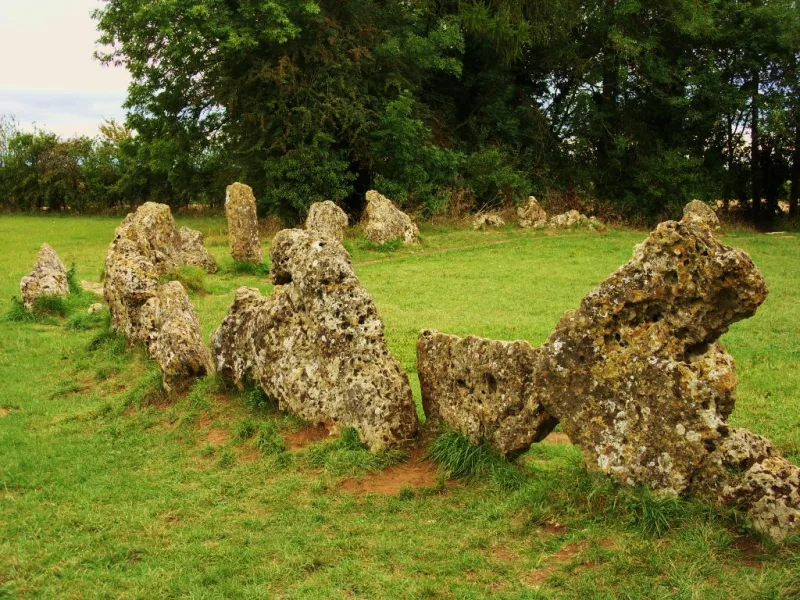
Rollright Stones
A 4,500-year-old stone circle on the Oxfordshire–Warwickshire border, with an older Neolithic burial dolmen and a probable Bronze Age standing stone — the most accessible major prehistoric site within reach of Oxford.
The Rollright Stones sit on the Cotswold scarp where Oxfordshire meets Warwickshire, about 2.5 miles north-northwest of Chipping Norton. The site is not one monument but three, built at different times across the Neolithic and Bronze Age — between the 4th and 2nd millennia BCE. They are the closest major prehistoric complex to Oxford, and arguably alone in being within reach for a half-day trip.
The three monuments
The Whispering Knights are the oldest part of the site: the remains of an Early or Middle Neolithic portal dolmen — a small burial chamber. Four standing stones survive, leaning around a fifth recumbent stone that was probably the collapsed roof capstone. They sit 400 metres east of the main circle.
The King's Men is the stone circle itself: 33 metres across, currently composed of seventy-seven closely spaced stones of local oolitic limestone. It was built in the Late Neolithic or Early Bronze Age. Archaeologist George Lambrick, who led the formal investigation in the 1980s, argued that the stones were originally placed touching one another to form a continuous barrier. The circle has architectural parallels with sites in Cumbria — Swinside in particular has an almost identical layout — implying a long-distance connection through prehistoric trade or ritual networks.
The King Stone stands alone, 76 metres north of the circle: a single weathered monolith 2.4 metres high and 1.5 metres wide, on the Warwickshire side of the border. Its date is uncertain. Lambrick's tentative reading, after weighing six earlier hypotheses, was that it served as a Bronze Age cemetery marker.
Folklore
The names — King's Men, Whispering Knights, King Stone — descend from a folk tale that was already established by the early modern period. A king and his army were riding across the country when they were challenged by a witch (Mother Shipton in some versions). She turned the king to stone, his soldiers into the circle, and four straggling knights, caught whispering treason behind their leader, into the dolmen. William Camden recorded a rhyming version in 1610.
Local belief layered on top of the medieval framework. By the 19th century, girls from neighbouring villages were said to run naked around the stones at midnight on Midsummer's Eve in the hope of seeing the man they would marry; childless wives were said to pray near the King Stone for fertility. These are folk customs, attested by 19th-century writers rather than evidenced earlier — legend layered on legend.
The earliest written account is older than the folktale itself: a 14th-century tract called De Mirabilibus Britanniae (Wonders of Britain) names the site "Rollendrith" alongside Stonehenge and the Uffington White Horse.
Heritage and ownership
The Rollright Stones have been a scheduled monument since 1882 — one of the first sites protected under English heritage law. In the late 1990s, when the then-owner decided to sell, a campaign of local supporters (including Pagans who used the site for ritual) raised the funds to buy it through donations and a grant from the Hanson Environment Fund. The deeds were handed to the newly-formed Rollright Trust (registered charity no. 1068450) in 2001. The Trust receives no state or private funding and depends on visitor contributions; it has reinforced the paths to enable wheelchair access to the Whispering Knights.
Living site
The stones remain in active use. The Bricket Wood coven of Gardnerian Wiccans met at the King's Men in 1959, and the site has been a focal point for various forms of Contemporary Paganism ever since. The Trust permits Pagan groups to book the site for ceremonies, and visitors will sometimes find offerings — flowers, tea lights, occasional crystals — left in cracks between the stones. Most are quietly tidied; only those that damage the stones (lit fires, coins jammed in fissures) cause concern.
The site has filmed cameos in popular culture too — the Doctor Who serial The Stones of Blood (1978) used the King's Men as its fictional Cornish circle, and Anish Kapoor's sculpture "Turning the World Inside Out" was installed at the centre of the circle for several months in 2003.
Visiting
The site is unstaffed in the conventional sense — pay the small admission at the honesty box for the King's Men circle, then walk between the three monuments at your own pace. The King Stone is across the road on the Warwickshire side; the Whispering Knights are reached by a short path east through the field. Allow an hour and a half if you want to take in all three.
By car from Oxford the route runs through Chipping Norton — combine the trip with the market town's pubs and shops, or extend west into the Cotswolds. There is no direct public transport to the site itself; the nearest train station is Kingham, a short taxi ride away.