St Peter-in-the-East
A 12th-century church on Queen's Lane, deconsecrated in the 1970s and now the library of [St Edmund Hall](/places/colleges/st-edmund-hall/) — with a small garden churchyard, a bronze statue of St Edmund as an impoverished student, and a Domesday Book mention from c.1085.
Read the building from the outside — the church is a working college library and not a tourist site, but the garden churchyard is part of the Hall’s normal visitor route. The bronze of St Edmund (the early Archbishop of Canterbury who lived here as a student and donated the Lady Chapel in the early 13th century) sits in the north garden.
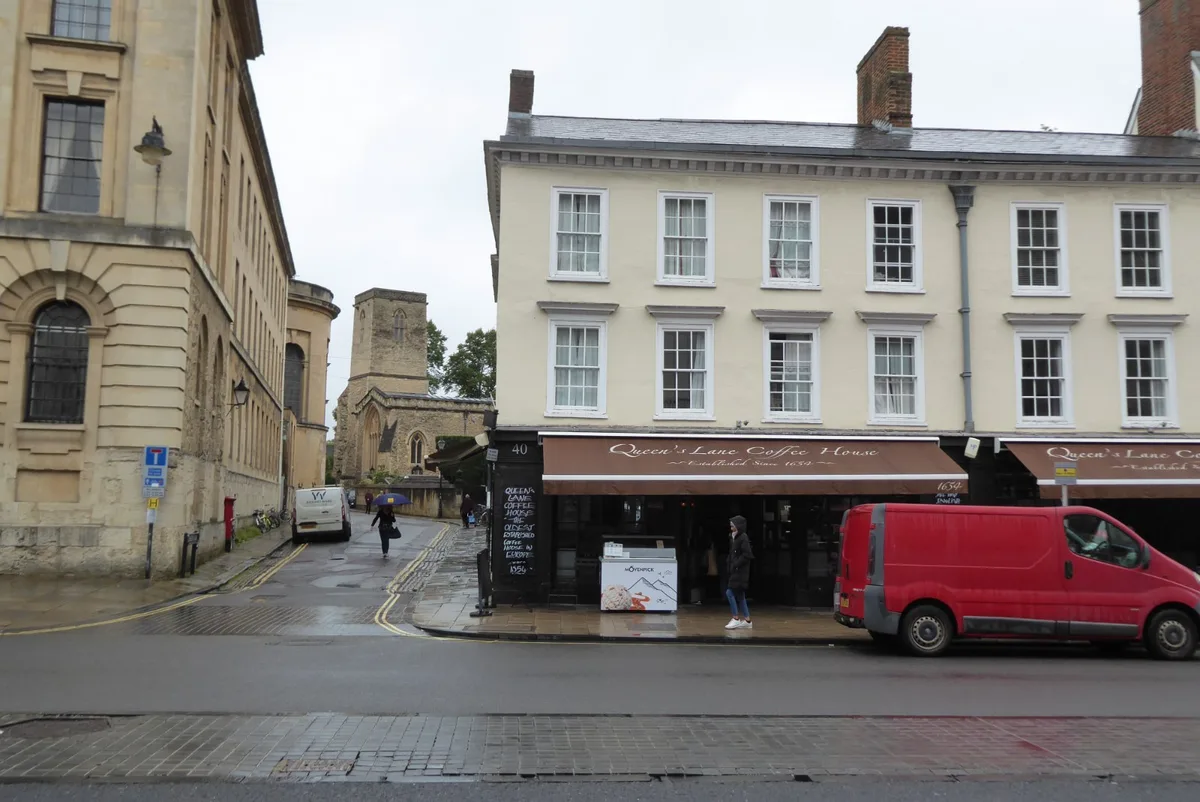
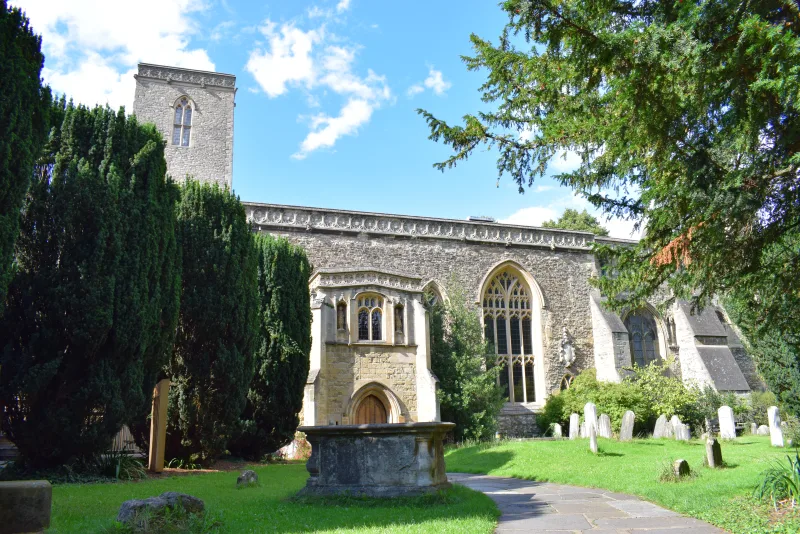
Tucked into Queen's Lane just off the High Street, St Peter-in-the-East is a small Norman church that has, since the 1970s, served as the library of St Edmund Hall. The walled garden to its north — what was once the churchyard — remains open as part of the Hall's visitor route and holds a seated bronze of St Edmund of Abingdon depicted as a poor undergraduate.
A church since the late 10th century
The site has carried a place of worship since the late tenth century. By the time of Domesday (c.1085) the building was already stone-built and substantial enough to be recorded — the survey notes that "the church of St. Peter Oxenford" held two hides at Haliwelle of Robert d'Oilly, with its annual value lately doubled from twenty shillings to forty. The current dedication, distinguishing it from St Peter-le-Bailey out by Oxford Castle, reflects its position close to the medieval East Gate; it came into use in the early twelfth century.
The Norman core that survives — crypt, chancel and most of the nave — was raised around 1140 under Robert d'Oilly, then governor of the town. In 1266 Henry III made the church over to Walter de Merton, and from that grant onward Merton College controlled the living. Both Wolvercote and Holywell began their parish life as outlying chapels of ease attached to St Peter's.
Successive medieval additions are still legible. A north aisle went up in the thirteenth century; the tower followed in the fourteenth, when most of the present windows were also cut; the door through into the tower is a sixteenth-century insertion. At the east end of the aisle stands a small early-Tudor chapel dedicated jointly to St Catharine and St Thomas. The Lady Chapel is older — an early-thirteenth-century gift from Edmund Rich of Abingdon, then a young scholar lodging in the hall next door and later, as Archbishop of Canterbury, the saint after whom the college took its name.
Closure and conversion
Numbers fell sharply across the twentieth century, in large part because the residential population of the old city centre had drained away after the First World War. Regular worship ceased in 1965, deconsecration followed in the 1970s, and the building was adapted, with minimal interference to the fabric, into the present-day St Edmund Hall library.
Nearby
Within a few minutes' walk