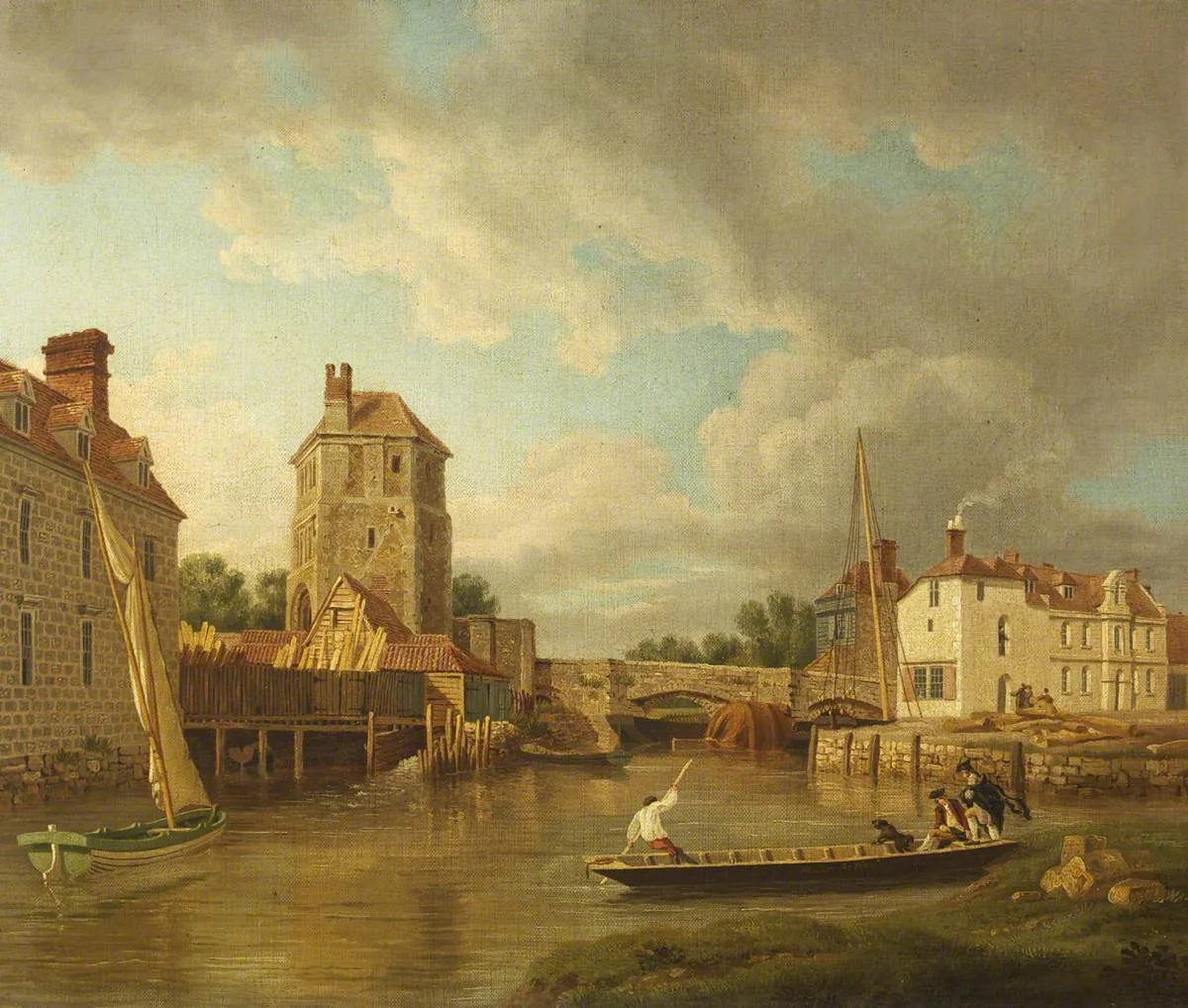
Friar Bacon's Study
A medieval tower at the north end of Folly Bridge, demolished 1779. The 13th-century Franciscan friar Roger Bacon — one of the earliest European advocates of the scientific method — is said to have lived and worked here.
There is nothing to see on the site itself, but Worcester College keeps the Michael Angelo Rooker painting of the tower in its collection. Pair this stop with a Folly Bridge crossing and a coffee at The Head of the River.
A vanished landmark, but a satisfying one to stand near. Until 1779, Folly Bridge had a stone tower rising from its north end. Tradition called it Friar Bacon's Study and pointed to a famous occupant from five centuries earlier: Roger Bacon — Doctor Mirabilis — Franciscan friar, polymath, and one of the earliest European advocates of what later generations would call the scientific method.
The man
Roger Bacon was born in Somerset around 1219 or 1220 and studied at Oxford in the 1230s, lecturing on Aristotle as a Master before crossing to Paris to teach. He returned to Oxford as a private scholar around 1248 and joined the Franciscan Order in 1256 or 1257. The order's restrictions on his publishing made the next decade frustrating, but a chance correspondence with Cardinal Guy de Foulques — soon Pope Clement IV — opened a brief window of patronage. Between 1267 and 1268 Bacon dispatched the Pope a torrent of work: the Opus Majus, Opus Minus, Opus Tertium, treatises on optics, and an actual lens. Around a million words of writing in roughly a year — a feat unmatched in the medieval university's record.
Two passages — one in Opus Majus, one in Opus Tertium — are usually taken as the first European descriptions of a mixture containing the essential ingredients of gunpowder. The image of the medieval friar grinding saltpetre into the recipe for modern explosives is what later generations latched onto: by the early modern era Bacon was being remembered as a wizard, particularly famed for the story of his mechanical or necromantic brazen head.
After 1278 Bacon returned to the Franciscan House at Oxford and is presumed to have spent the rest of his life there. He died around 1292 and was buried at Oxford.
The tower
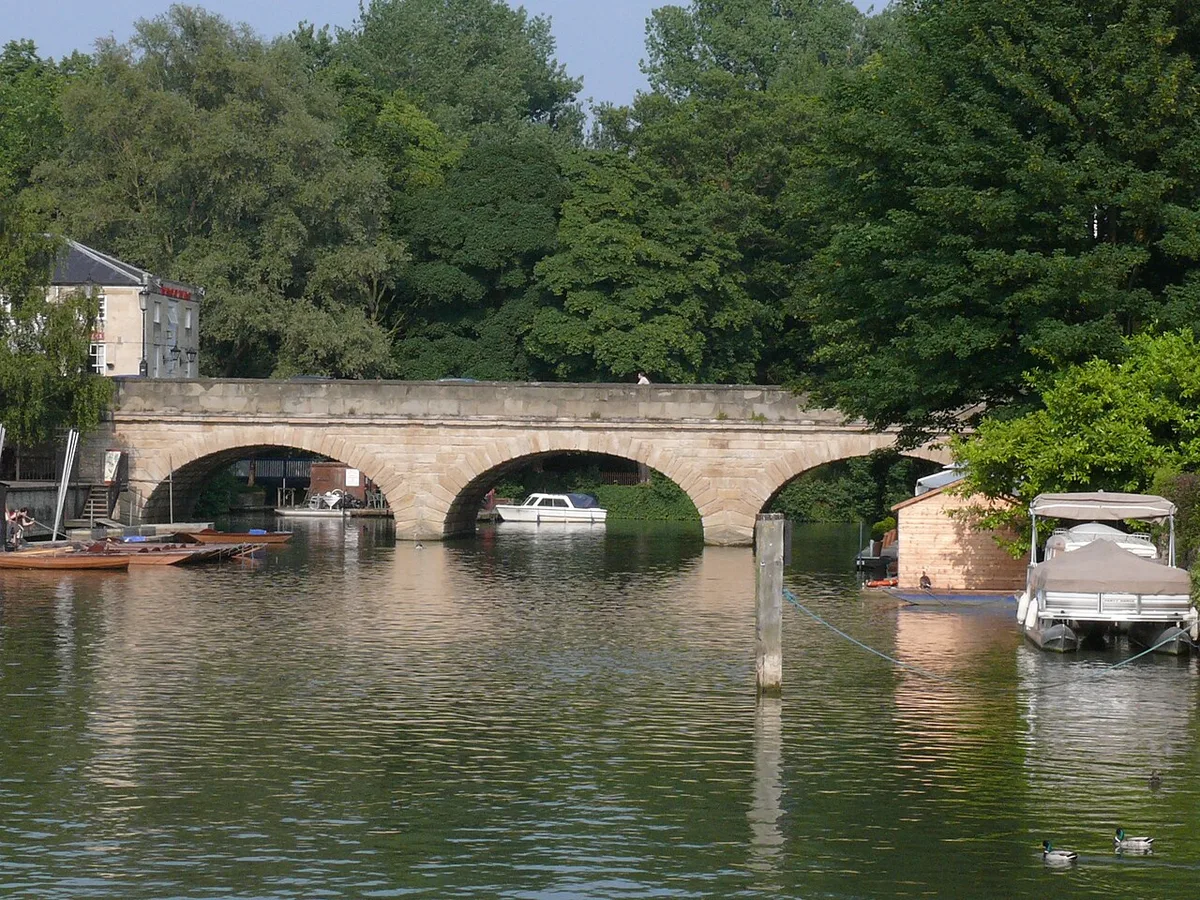
The structure that bore his name stood across the north end of Folly Bridge — then known as South Bridge, part of the long causeway called Grandpont that carried the Abingdon Road across the Thames floodplain. Until the late 17th century the bridge itself was unremarkable; the tower was the showpiece. Samuel Pepys came to see it in 1669 and recorded the visit in his diary in characteristically Pepysian voice: "So to Friar Bacon's study: I up and saw it, and gave the man 1s." A shilling for the climb up — already in the 1660s the building was being shown as a curiosity.
The Folly part of the bridge's modern name may date from this period. The origin is uncertain, but tradition holds that it began about 1650 after a tenant of Bacon's study built additions to the old tower that the city found ridiculous.
The tower was drawn by many artists in its last years, including the twelve-year-old J. M. W. Turner. Michael Angelo Rooker's painting — the one at the head of this page — shows the tower in something close to its final state, before it was removed in 1779 to widen the road. The bridge that survives now was built between 1824 and 1827, to designs by Ebenezer Perry, and is Grade I listed.
Was Bacon really here?
Possibly not. Wikipedia repeats the local tradition — "in the 13th century, the alchemist Roger Bacon lived and worked at 'Friar Bacon's Study'" — but Bacon's biography places him at the Franciscan House (the lost Greyfriars priory near St Ebbe's, on the other side of the city) for much of his Oxford career. The tower above Folly Bridge may have been a later attribution, the kind of association Oxford has always been ready to forge between buildings and legendary occupants. Either way, the structure is gone now, and what survives is the legend, the bridge, and the view across the Thames.
Visiting
The site is on the north end of Folly Bridge, where the Abingdon Road meets the Thames. There is nothing on the site to mark it, but the bridge itself is worth standing on — at the very ford where, according to the same Wikipedia article, oxen were once driven across the Isis to give the city its name. Combine with the Thames Path walk through Oxford, or pause at The Head of the River at the bridge's northeast end. For Bacon, the trail leads west to St Ebbe's, where the Franciscan House once stood, and onward into the lost medieval Oxford.
Nearby
Within a few minutes' walk