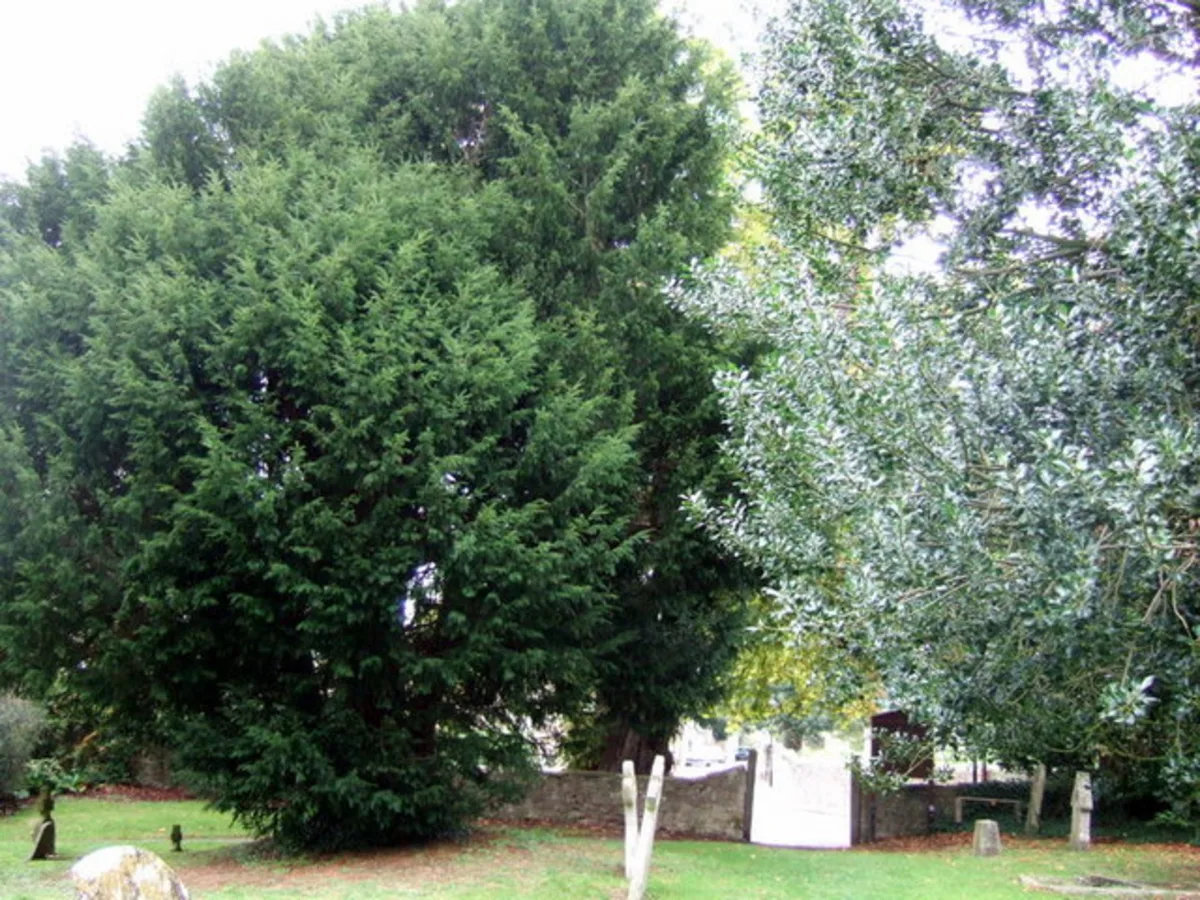
The Iffley Yew
An ancient yew at the entrance to one of England's finest Norman churches — paired inside by John Piper's Tree of Life and Roger Wagner's Flowering Tree windows.
Pair the yew outside with the Piper and Wagner Tree-of-Life windows inside — three takes on the same idea, separated by eight or nine centuries.
Iffley's churchyard yews stand at the entrance to St Mary the Virgin, and have done for as long as anyone has counted. They are locally famous; one of them is traditionally said to predate the church. Specific ages quoted for the oldest of the yews range up to 1600 years, but no authoritative dendrochronology backs those figures, and they should be read as folk-attribution, not science. Even taken cautiously, the yew is one of the older living things you can stand under in Oxford.
The church it grew up around
The church the yew shades is among England's most intact small Norman churches. It was built around 1160 by the Norman family of St Remy, who held Iffley from 1156 until about 1200 and established it as a parish — the work probably financed with funds from the de Clintons of Kenilworth Castle. The east end was extended in the Early Gothic style around 1230, when a cell was constructed on the south side for the anchoress Annora. The building has barely changed since: round-arched windows and doorways throughout, with the elaborate Romanesque carvings of beakheads and zigzag mouldings on the west front that draw architectural visitors out from the city. It is Grade I listed.
The Tree of Life inside
The other reason to come to Iffley is the modern stained glass — chosen, it is hard not to suspect, partly to echo the yew at the door. In the south wall of the nave is John Piper's Tree of Life window, designed by Piper, made by glassmaker David Wasley in 1982 for an exhibition in Bristol, and installed at Iffley in 1995 after Piper's widow Myfanwy gifted it to the church. Five animals are arranged on the branches, each proclaiming the Nativity in Latin: Cock — Christus natus est (Christ is born); Goose — Quando? Quando? (When? When?); Crow — In hac nocte (On this night); Owl — Ubi? Ubi? (Where? Where?); Lamb — Bethlehem! Bethlehem!
Opposite, a Flowering Tree window designed by Roger Wagner and realised in glass in 2012 (by Patrick Costeloe of the Thomas Denny studio) sets up the same image again in a different idiom.
The two glass trees inside, and the living tree at the door, are best read together. Yews in churchyards are themselves a long tradition — older than the churches built beside them, in many places — and at Iffley the church chose to extend that tradition into stained glass twice over.
Visiting
Iffley village is a mile and a half south of the city centre on the eastern bank of the Isis, in a designated conservation area, between Cowley and Rose Hill. The churchyard is open during the church's normal hours, free of charge. The Thames Path passes the foot of the village, so the yew pairs naturally with a longer riverside walk via Iffley Lock and back into the city. Inside Oxford, Tolkien's tree at the city's botanical garden is the natural counterpart — another famous Oxford tree, no longer there.