Uffington White Horse
Britain's oldest chalk hill figure — a 110-metre stylised horse cut into the Berkshire Downs scarp at some point between 1380 and 550 BC, scoured and re-chalked by villagers for at least three thousand years.
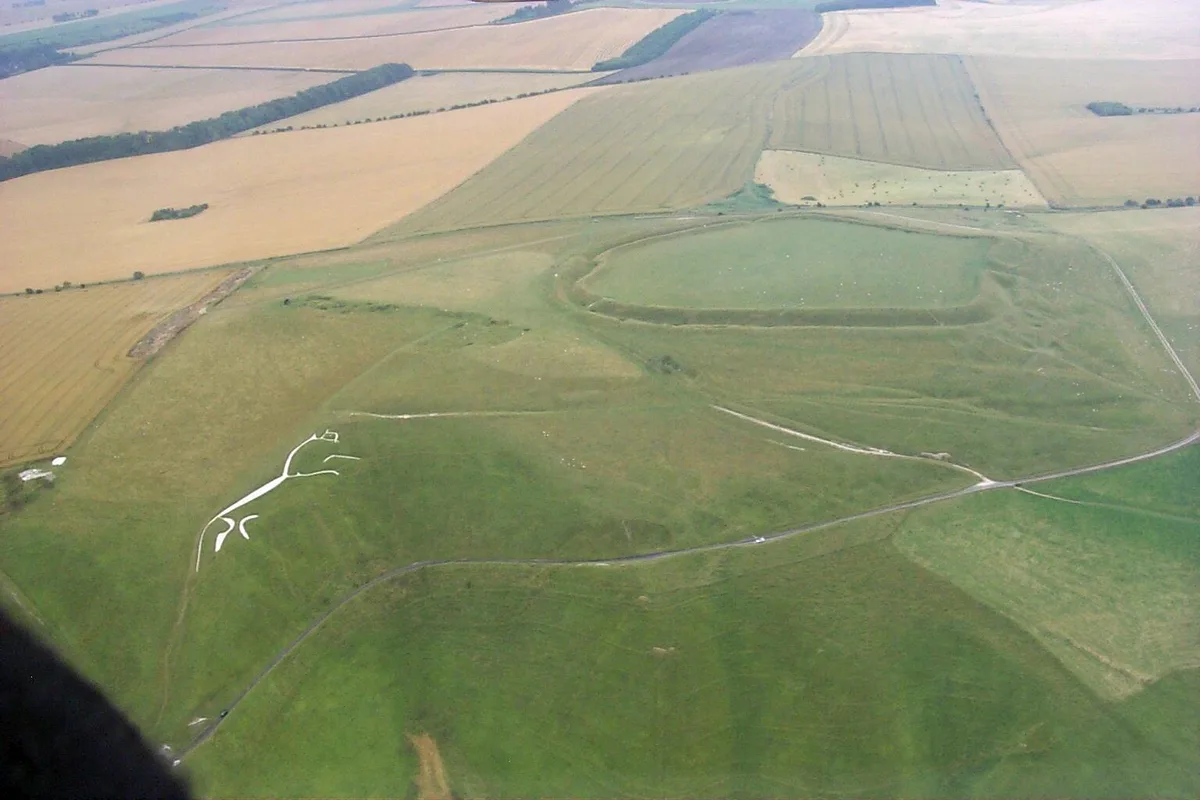
The Uffington White Horse is a stylised hill figure cut into the chalk scarp of the Berkshire Downs, on the upper slopes of Whitehorse Hill in the parish of Uffington. It is 110 metres long, formed not from exposed bedrock but from deep trenches packed with crushed white chalk — which means the figure is, in effect, a piece of architecture rather than a graphic, and it disappears within a few years of neglect. The clearest views are from across the Vale or from the air; standing on the figure itself, the form is almost unreadable.
A Bronze Age figure
The horse is by far the oldest of the white horse hill figures in Britain — the others, all later, copy the idea but use a different design. Its date was settled in 1990, when Simon Palmer and David Miles of the Oxford Archaeological Unit excavated the trenches and applied optically stimulated luminescence dating to the silt within them. The dating placed the figure between 1380 and 550 BC, making it Britain's oldest chalk figure and a contemporary of nearby Uffington Castle, the Iron Age hillfort that sits on higher ground above it.
Earlier theories had placed the horse much later. In the seventeenth century, John Aubrey attributed it variously to Hengist and Horsa or to Iron Age Celtic tribes, noting its similarity to images on local coinage. Francis Wise speculated, more romantically, that Alfred the Great had cut it to celebrate his victory at Edington. Stuart Piggott in the early twentieth century proposed an Iron Age date of around 100 BC; Morris Marples later suggested the Bronze Age on stylistic grounds. The 1990 luminescence work was definitive.
What does it represent?
The figure has been called a horse since at least the eleventh century — a cartulary of Abingdon Abbey compiled between 1072 and 1084 refers to mons albi equi at Uffington, "the White Horse Hill". The earliest surviving description comes from medieval Welsh literature: the Llyfr Coch Hergest (Red Book of Hergest, 1375-1425), which records a "mountain with a figure of a stallion upon it, and it is white. Nothing grows upon it."
What the figure was for is harder. The general view among archaeologists is that it represents a tribal symbol, perhaps the emblem of the community that built and used Uffington Castle. The design closely resembles horses on the coinage of the Dobunni and Atrebates and on the Iron Age Marlborough Bucket. Joshua Pollard at the University of Southampton has proposed an alignment-based reading: the horse's body is oriented to the path of the sun, particularly at midwinter, and may have been intended as a "solar horse" carrying the sun across the sky.
Scouring
The horse exists at all because, for at least three centuries and probably much longer, local villagers periodically cleared the trenches and replaced the chalk. The work is called the Scouring of the White Horse, and it was for centuries the occasion of a country fair. Francis Wise wrote in 1736 that "the ceremony of scouring the Horse, from time immemorial, has been solemnized by a numerous concourse of people from all the villages roundabout."
The recorded scouring festivals ran from 1755 to 1857; the final one drew around thirty thousand people and was deemed too rowdy to repeat. Thomas Hughes — author of Tom Brown's Schooldays, born in Uffington — published The Scouring of the White Horse in 1859, a semi-fictionalised account of the 1857 festival. The tradition was revived by the National Trust in 2009 with a smaller volunteer event on the Spring Bank Holiday weekend; "Chalking Days" continue today, with volunteers kneeling on the figure to break the chalk into a paste and re-whiten the trenches by hand.
During the Second World War the figure was deliberately covered with turf and hedge trimmings to deny Luftwaffe pilots a navigation landmark; it was uncovered after the war by the Welsh archaeologist William Francis Grimes. Most recently, in summer 2024, Oxford Archaeology — working with the National Trust and English Heritage — began a major restoration to reverse the gradual shrinkage of the figure since the 1980s and return it closer to its original shape.
What else is on the hill
The horse overwhelmingly dominates White Horse Hill in the public imagination, but far from exhausts what's worth seeing here.
Uffington Castle, immediately above the figure, is a single-rampart Iron Age hillfort enclosing about three hectares (7.4 acres). The bank and ditch are well preserved and the views from the rampart take in most of the Vale.
Dragon Hill is the squat, flat-topped chalk knoll just below the horse. It is a natural feature given an artificial flat top in antiquity, and folklore holds it as the spot where St George slew the dragon — present that as legend, not fact.
The Manger is the steep dry valley below the figure, with terraces along its flanks known as the Giant's Stair. Local legend says the horse comes down to graze in the Manger at night.
The Blowing Stone is a perforated sarsen in a garden in nearby Kingston Lisle. It produces a low musical tone when blown through, and is one of those objects whose folklore — that whoever can sound it from the hill is the rightful king — is older than the explanation for it.
Wayland's Smithy is a Neolithic chambered long barrow about a mile and a half southwest of the horse, beside The Ridgeway. The Ridgeway itself runs behind Uffington Castle and continues as the Ridgeway National Trail from Overton Hill near Avebury all the way to Ivinghoe Beacon in Buckinghamshire — pairing the horse with the Smithy is the classic walk. Whitehorse Hill is also a Site of Special Scientific Interest, both geological (Pleistocene sediments) and biological (one of the few unploughed grassland slopes left on the Oxfordshire chalk).
In 2019, water-pipe workers near Letcombe Bassett unearthed an almost three-thousand-year-old settlement that archaeologists believe belonged to the same community that cut the horse. The find included tools, animal bones, and the remains of twenty-six people whose skeletons suggest human sacrifice — a sobering counterpoint to the horse as a piece of "minimalist art."
Cultural afterlife
The horse runs deep in English literary memory. G.K. Chesterton built his 1911 epic The Ballad of the White Horse around it, framing the scouring as a metaphor for King Alfred's England. Tom Shippey has argued that Tolkien — a long-time Oxford resident — drew on the Uffington figure for the white-horse-on-green-field banner of the riders of Rohan. Terry Pratchett confirmed that the horse on the chalk in his Tiffany Aching novels (from A Hat Full of Sky, 2004) was inspired by Uffington. The figure appears on the cover of XTC's English Settlement (1982) and on the back cover of Nirvana's In Utero (1993). The BBC television serial The Moon Stallion by Brian Hayles incorporated both the horse and Wayland's Smithy in 1978, treating the whole hill as a place where the modern world is, briefly, somewhere else.