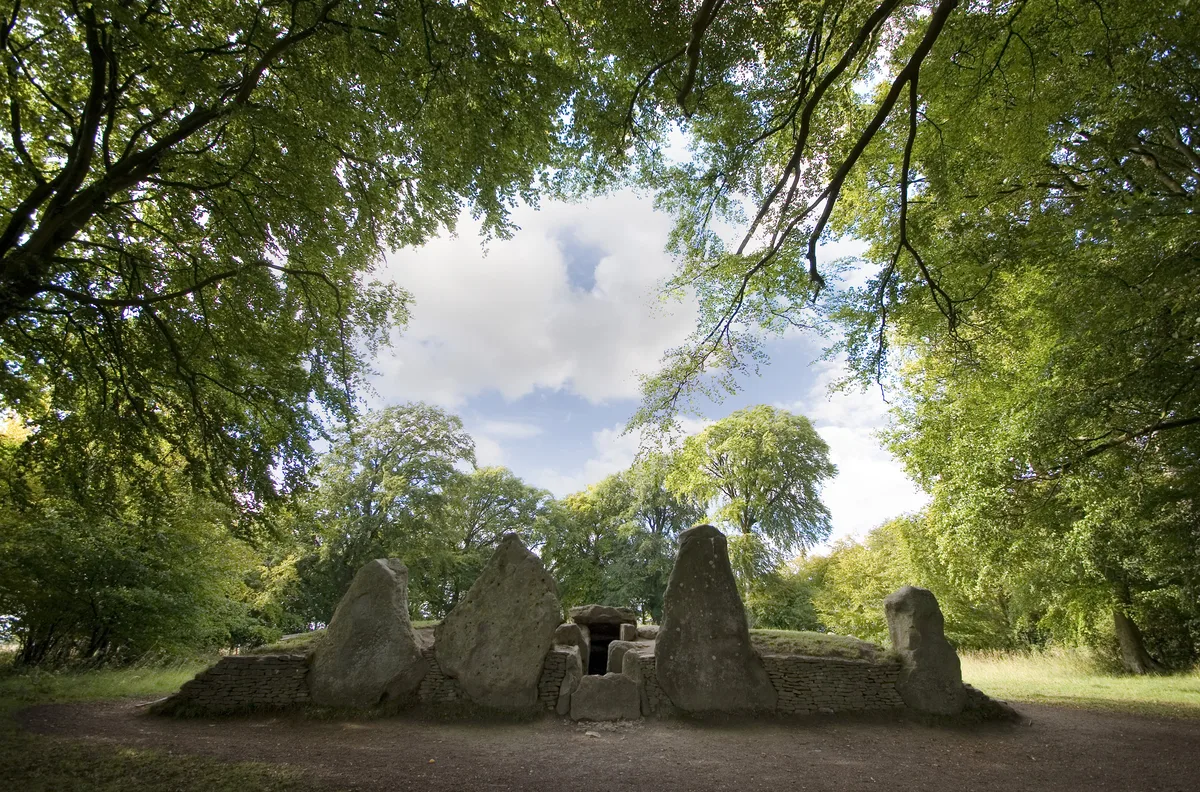
Wayland's Smithy
An Early Neolithic chambered long barrow on the Ridgeway, completed around 3430 BCE — among Britain's best-preserved Severn-Cotswold tombs and a long day's walk from the Uffington White Horse.
Wayland's Smithy is an Early Neolithic chambered long barrow on the Ridgeway, near the village of Ashbury in the Vale of White Horse. It was completed around 3430 BCE — within a few centuries of the introduction of agriculture to Britain — and is among Britain's best-preserved Severn-Cotswold group tombs, a localised variant of long barrow built only in south-western Britain.
Two phases
The barrow was built in two distinct phases, separated by perhaps a century. The first, around 3590-3550 BCE, was a small timber-chambered oval barrow: a paved stone floor with two large posts at either end, holding a single crouched burial and the disarticulated remains of fourteen further individuals. Analysis of the bones showed that the dead had been left to excarnate before burial, then deposited in possibly four separate phases. The whole was covered by an earth mound about 4.6 metres wide.
The second phase, around 3460-3400 BCE, replaced this with a much larger trapezoidal stone-chambered tomb. Two opposing transept chambers and a terminal chamber open from a longer entrance passage, giving the burial area a cruciform plan. Four large sarsen stones stand at the entrance — originally six, two now lost — re-erected in their upright positions following the 1962-63 excavations by Stuart Piggott and Richard Atkinson. The current restored appearance of the site is the result of their work. An earlier excavation in 1919 had revealed the jumbled remains of seven adults and one child within the stone tomb.
The transition from timber to stone, possibly within a single human generation, is one of the reasons archaeologists value the site: it captures a moment of change in how Neolithic Britain buried and remembered its dead.
Naming
The barrow was already four millennia old when it acquired its current name. Wayland — Wolund in older sources — is a Germanic smith-god who appears in Norse mythology and is depicted on the eighth-century Franks Casket in the British Museum. The Saxons who settled the Berkshire Downs gave the long-abandoned tomb to him.
The earliest written record of the name comes from a land deed of 908 AD relating to nearby Compton Beauchamp, with the name later documented in a charter of King Eadred dated 955 AD.
Folklore
In 1738, Francis Wise — then under-keeper of the Bodleian Library — recorded the local belief about the site:
At this place lived formerly an invisible Smith, and if a traveller's Horse had lost a Shoe upon the road, he had no more to do than to bring the Horse to this place with a piece of money, and leaving both there for some little time, he might come again and find the money gone, but the Horse new shod.
This is a folk legend attested in the eighteenth century — present it as legend, not history. Walter Scott picked the story up in his 1821 novel Kenilworth, where the site is "Wayland Smith's Forge"; the 1828 one-inch Ordnance Survey map followed, and the folklorist Leslie Grinsell argued the map's naming was probably influenced by Scott. Rudyard Kipling later set many of his Puck of Pook's Hill stories near the Smithy and opened the collection with the smith god's arrival; Susan Cooper's The Dark is Rising sequence carries a character named Wayland Smith. The 1978 BBC miniseries The Moon Stallion incorporated both the Smithy and the nearby Uffington White Horse into a story set in 1906, with the stones associated with witchcraft. Radiohead recorded the music video for their non-album single "Pop Is Dead" at the site.
Modern use
Visitors have lodged coins in the cracks of the stones since at least the 1960s. National Trust wardens periodically clear them, and the proceeds are donated to local charities. Around 2010, English Heritage removed the explanatory note about coin deposition from the on-site information panel — there is no organised tradition to follow, only the informal one. Modern Pagan groups, including Druids and Heathens, have used the barrow as a ritual site since the late twentieth century.
Heritage and access
The barrow is a scheduled monument (Historic England list entry 1008409) under the guardianship of English Heritage. There is no admission charge, and the site is open all year round. There is no on-site parking and no road access — the standard approach is on foot along the Ridgeway National Trail. Most visitors walk in from the Uffington White Horse car park, which is signed off the road south of Woolstone; the path is straightforward and well-trodden. Allow time at the barrow itself; the site is small but rewards a quiet half-hour.
The barrow sits on the same hill range as the Uffington White Horse and Uffington Castle — pairing them in a single walk is the obvious approach. The Rollright Stones make a comparable Neolithic-to-Bronze-Age comparison further north on the Cotswold scarp.