78 Banbury Road (Murray's Scriptorium)
The North Oxford house where James Murray edited the first edition of the Oxford English Dictionary from a corrugated-iron shed in the back garden — the original Scriptorium, with 1,029 pigeon-holes and a Post Office postbox of its own.
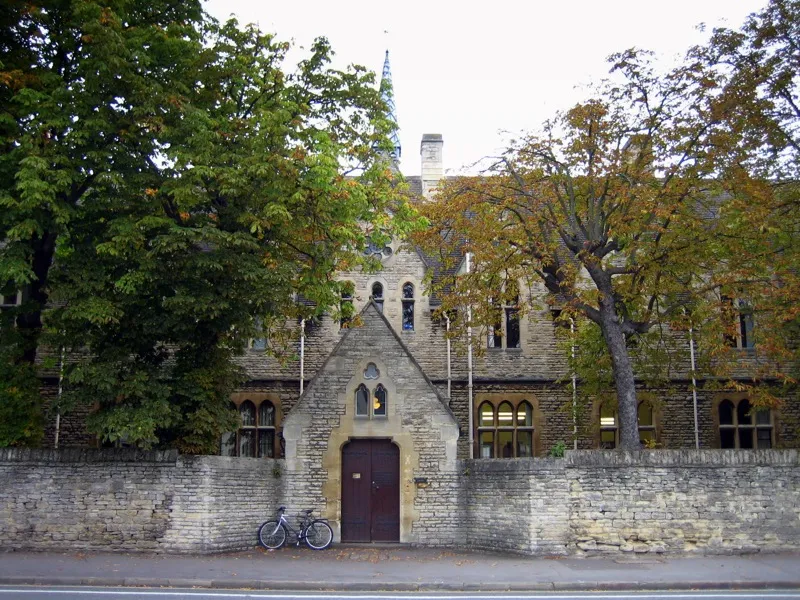
Behind the front door at 78 Banbury Road — a large brick North Oxford villa indistinguishable, at first glance, from its neighbours — stood for fifty years the most consequential garden shed in English lexicography. The corrugated-iron building known as the Scriptorium was where James Murray and his team built the first edition of the Oxford English Dictionary. The Scriptorium is long gone; the house remains, and so does the blue plaque.
How the Scriptorium came to Oxford
Murray accepted the editorship of the new English dictionary in 1878 and signed the formal agreement on 1 March 1879. Before he ever lived in Oxford he had built the first Scriptorium in the grounds of Mill Hill School in north London, where he was teaching: a corrugated-iron shed lined with wooden planks, bookshelves, and 1,029 pigeon-holes for quotation slips. Volunteers — over a thousand of them, worldwide — were sending him slips at the rate of a thousand a day. By 1880 he had accumulated two and a half million.
In the summer of 1884 the family moved to a large house on the Banbury Road. The first dictionary fascicle — A to Ant, 352 pages, twelve shillings and sixpence — had been published on 1 February of that year, twenty-three years after Coleridge's sample pages. The OUP delegates had concluded that, at the rate then prevailing, the dictionary would never be finished unless Murray gave up teaching and moved to Oxford full-time. He did so in 1885. The original corrugated-iron Scriptorium was dismantled, transported, and re-erected — larger this time — in the back garden of the new house.
Life in the Scriptorium
The volume of post sent to and from the Scriptorium was such that the Post Office erected a special post box outside the house. Anything addressed simply to "Mr Murray, Oxford" found its way to him. Murray became president of the Oxford Philatelic Society, putting to use the substantial stamp collection that arrived with his international correspondence.
He had eleven children with his second wife Ada — all of whom, unusually for the time, survived to maturity, and all of whom helped sort and file slips. Two of his most prolific outside contributors corresponded with him from unlikely places. The American surgeon William Chester Minor, confined to Broadmoor Criminal Lunatic Asylum after a killing in London, devised his own quotation-tracking system and submitted on demand; Murray first visited him there in January 1891, and in 1899 paid him this compliment in print: "we could easily illustrate the last four centuries from his quotations alone." Later, between 1919 and 1920, a young J. R. R. Tolkien was employed on the dictionary, researching etymologies of words in the Waggle-to-Warlock range — and would in due course parody the principal editors as "The Four Wise Clerks of Oxenford" in Farmer Giles of Ham.
What it became
When the first edition was completed in 1928, thirteen years after Murray's death, it had grown from the expected four volumes and seven thousand pages to twelve volumes, 414,825 words, and 1,827,306 illustrative citations. Murray was knighted for the work in 1908 and received an Oxford honorary doctorate only in 1914, the year before he died — he was never made a Fellow of an Oxford college.
He died at the house of pleurisy on 26 July 1915 and is buried, as he had asked, beside the Sinologist James Legge in Wolvercote Cemetery.
Visiting
78 Banbury Road remains a residential house in North Oxford. The blue plaque is mounted on the front, visible from the pavement; the back garden where the Scriptorium stood is not in public view. Treat it as a one-minute stop on a North Oxford walk along Banbury Road — view from the pavement and respect the residents.
Nearby
Within a few minutes' walk