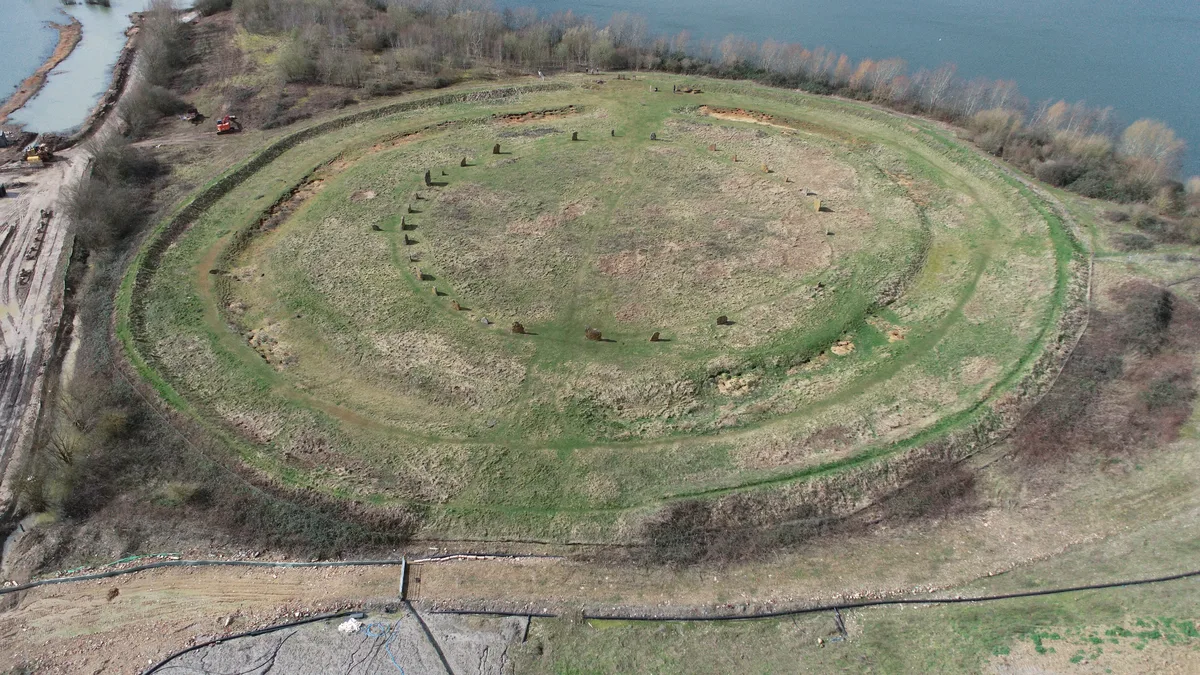
The Devil's Quoits
A Late Neolithic henge and stone circle at Stanton Harcourt, levelled by a wartime airfield, then chewed by gravel quarrying, then reconstructed almost from scratch between 2002 and 2008.
The Devil's Quoits is a Late Neolithic henge with a stone circle inside it, on the gravel terraces south of Stanton Harcourt. It is one of the closest major prehistoric monuments to Oxford — under ten miles west — and among Britain's most heavily reconstructed.
Form
The henge ditch enclosed a circular area up to 120 metres across, with opposed entrances facing almost due east and west; the northern half of the henge had a second outer ditch. Inside it stood a stone circle of slightly ovoid plan, around 79 metres at its widest, originally featuring 36 stones. A central stone setting may have been added later, in the Early Bronze Age, after the henge had been in active use for some time.
The site is at the centre of a wider complex of later prehistoric monuments — ring ditches, mortuary enclosures — buried under what is now a working gravel landscape.
Damage
By the start of the twentieth century the henge survived only as a slight earthwork and most of the stone circle had been broken up — most of the stones were removed by the end of the medieval period. By 1940 only one stone was still standing in its original position, with two others re-erected nearby. Then the site was systematically destroyed: a Royal Air Force airfield was built at Stanton Harcourt in 1940 in advance of expected bombing operations, and the runway construction levelled most of the surviving earthworks. After the war, the gravel beneath the site was extracted commercially.
That the monument exists at all today is the result of a long sequence of rescue archaeology. Excavations carried out ahead of gravel extraction in 1972, 1973, and 1988 recovered the complete plan of the henge and stone circle from postholes, ditch fills, and the buried bases of stones. Work on the ditch terminals revealed repeated use and deposition over a long period — hearths, animal bone, and human bone among the finds.
Restoration
Between 2002 and 2008, working with Hanson UK and Friends of the Devil's Quoits, archaeologists rebuilt the monument. The original quoits A, B and C were re-erected, along with other conglomerate stones found buried in the ditch or recovered during topsoil stripping. Twenty new replacement blocks of conglomerate sourced from a nearby quarry at Ducklington were dropped into the original empty stoneholes, bringing the circle back up to twenty-eight stones. The henge bank was rebuilt — soil had to be imported onto the site to do so — and brought up to two metres high, around half its original height. The earthworks were restored to the approximate condition they would have had at the start of Roman times, when the ditch was already filling with ploughsoil and the bank had begun to erode.
The result is, deliberately, not a replica of the Neolithic monument as it stood in 2500 BC. It is a reconstruction of a long-eroded earthwork around a partial recovery of an original stone circle, with modern stones standing in for those that have been lost. That makes it among Britain's most explicit post-war re-creations of a prehistoric monument — a site whose history includes its own destruction and rebuilding.
Folklore
The name predates the modern record. Local tradition holds that the Devil once played quoits with a beggar for the beggar's soul, and won by flinging the great stones across the Thames Valley from the top of Wytham Hill several miles to the east. It is folklore, not history, and the place is sometimes pointed out from the Swinford Farm trig point on Wytham Hill, which has the necessary commanding view across the valley.
Visiting
The Devil's Quoits is on permissive access, free, dawn to dusk, in what is now Dix Pit nature reserve at Stanton Harcourt. The site is scheduled (Historic England list entry 1011131). It pairs well with Wayland's Smithy and the Rollright Stones for a longer day comparing how three Oxfordshire monuments — Neolithic long barrow, Late Neolithic henge, Late Neolithic stone circle on the Cotswold scarp — are presented to the public after very different histories of survival and recovery.