St Michael at the North Gate
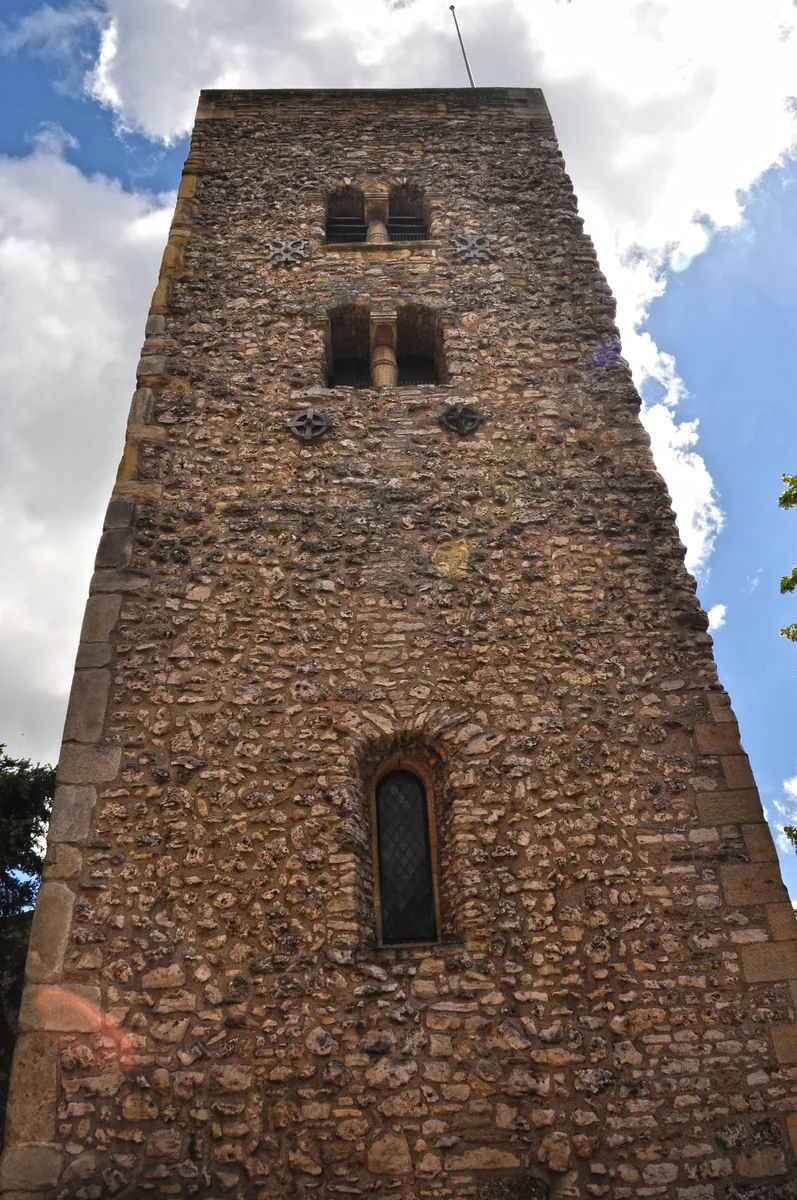
The Anglo-Saxon tower at the head of Cornmarket — c.1040, the oldest standing building in Oxford. The Bocardo Prison cell door behind which Cranmer, Latimer and Ridley were held in 1555-56 is preserved in the tower.
Climb the tower for a city view and the original clockwork mechanism. The cell door is small, dark, surprisingly affecting — pair this with the iron cross set into Broad Street outside Balliol (the burning site) and the Martyrs’ Memorial at the south end of St Giles’.
The squat stone tower at the head of Cornmarket Street is the oldest standing building in Oxford. The church behind it was built around 1000-1050; the tower itself dates from about 1040, raised in Coral Rag to flank the city's north gate. The architect John Plowman rebuilt the north aisle and transept in 1833, but the Saxon shaft survives — it is what you see when you stand at the bottom of Cornmarket and look up.
The Bocardo Prison
The north gate had rooms above it, used as a city lock-up known as the Bocardo Prison. The name was a logician's joke: in scholastic syllogism, "Bocardo" was a particularly difficult valid form to learn — and so, by folk-etymology, became the name of a prison hard to escape. Most of the inmates were ordinary debtors and petty offenders; in 1555 it briefly held the three most famous prisoners in English Reformation history.
Thomas Cranmer, the former Archbishop of Canterbury, was held with the Bishops Hugh Latimer and Nicholas Ridley while their trial for heresy made its way through the University Church on the High Street. Latimer and Ridley were burnt outside the city walls on 16 October 1555. Cranmer, after a year of recantations and counter-recantations, was burnt five months later, on 21 March 1556. The execution site is in Broad Street, marked by an iron cross set into the road outside the front of Balliol College — about three minutes' walk from where they were held. The Bocardo itself was demolished in 1771 to widen the road, part of John Gwynn's Georgian redevelopment of central Oxford. The cell door survived. It is now displayed in the tower of St Michael's, a few yards north of where the prison once stood.
City Church
St Michael's became the ceremonial City Church of Oxford in 1971, when All Saints' on the High Street was declared redundant and converted into the library of Lincoln College. The title had passed: from St Martin's at Carfax (demolished except for its tower in 1896), to All Saints', and finally to St Michael's. The church now serves as the place where the Mayor and Corporation of Oxford are expected to worship. Among other curiosities held in the tower: the marriage certificate of William Morris and Jane Burden, who were married here on 25 April 1859, and a pulpit once used by John Wesley.
Visiting
The church itself is open without charge during the day. The tower is accessible to the public — including the top, which provides one of the central city's best free-form views, and an original clockwork mechanism still in working order. The cell door is reached on the way up. For Reformation history, pair this with the iron cross in Broad Street and the Martyrs' Memorial at the south end of St Giles'.
Nearby
Within a few minutes' walk