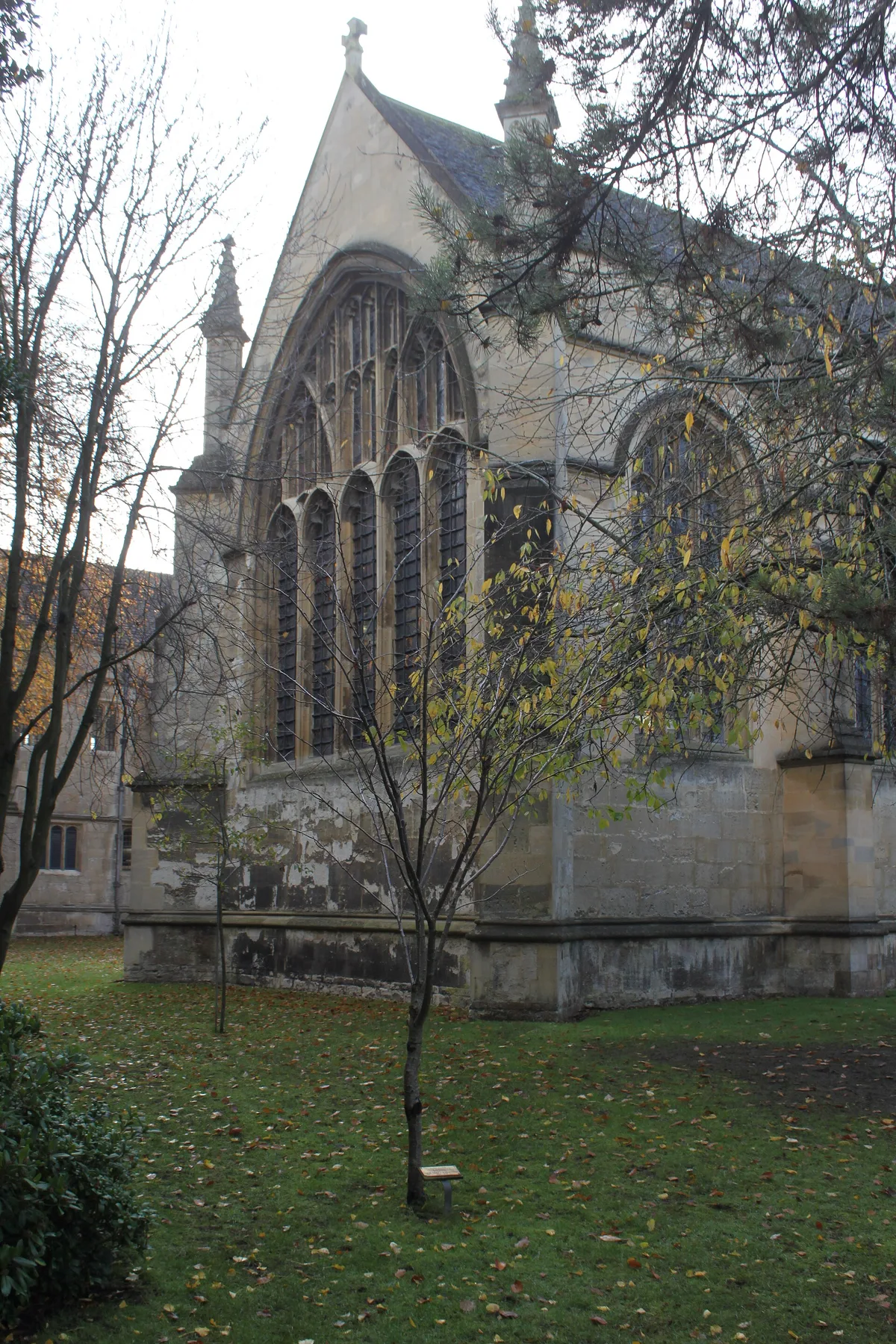
Wadham College Gardens
Four hundred years of gardens behind a Jacobean front quad — Wilkins's mound and mechanical curiosities under Cromwell, a Picturesque tree collection under Wills, and a Sheldonian Emperor's Head retired in the corner.
The ‘White Scented Garden’ is the quietest corner; the retired Sheldonian Emperor’s Head is set into the wall further back, easy to miss.
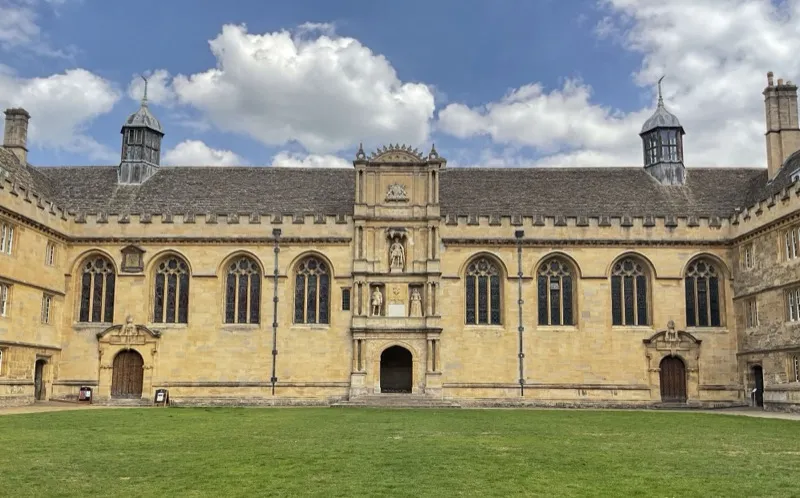
The gardens of Wadham College sit behind a notably intact Jacobean facade — one of Oxford's most complete. The college's central buildings were designed by William Arnold and put up between 1610 and 1613, and the gardens behind them are unusually large for a central Oxford college — even after the loss of the strip sold to build Rhodes House in the 1920s. The land was originally the orchards and market-gardens of the Augustinian priory that had stood on the site, and the present layout is the result of four centuries of constantly-changing functional and aesthetic use.
Wilkins, Cromwell, and the Royal Society
The first deliberate garden at Wadham was made under Warden John Wilkins (1648-1659) — Cromwell's brother-in-law, and a hugely influential scientific organiser of his century. Wilkins laid out a series of formal rectangles around a fashionable mound topped by a figure of Atlas, with a clutch of obelisks, a Doric temple, and a memorable collection of mechanical contrivances: a talking statue, a rainbow-maker. The gardens were of a piece with what Wilkins was doing inside the college — Christopher Wren attended the meetings of scientifically-inclined scholars that Wilkins hosted at Wadham in the 1650s, and the people who came to those meetings became, after the Restoration, the nucleus of the Royal Society at its foundation in 1662.
Wills, Shipley, and the Picturesque
Under Warden Wills (1783-1806), the terrain was radically remodelled and landscaped by Shipley. The formal rectangles went; the gardens became notable for a distinguished collection of trees, in the spirit of the Picturesque movement that was reshaping English landscape gardens at the same time. That collection of trees has carried through to today: present specimens include a holm oak, a silver pendant lime, a tulip tree, a golden yew, a purple beech, a cedar of Lebanon, a ginkgo, a giant redwood, a tree of heaven, an incense cedar, a Corsican pine, a magnolia, and a rare Chinese gutta-percha.
After the war
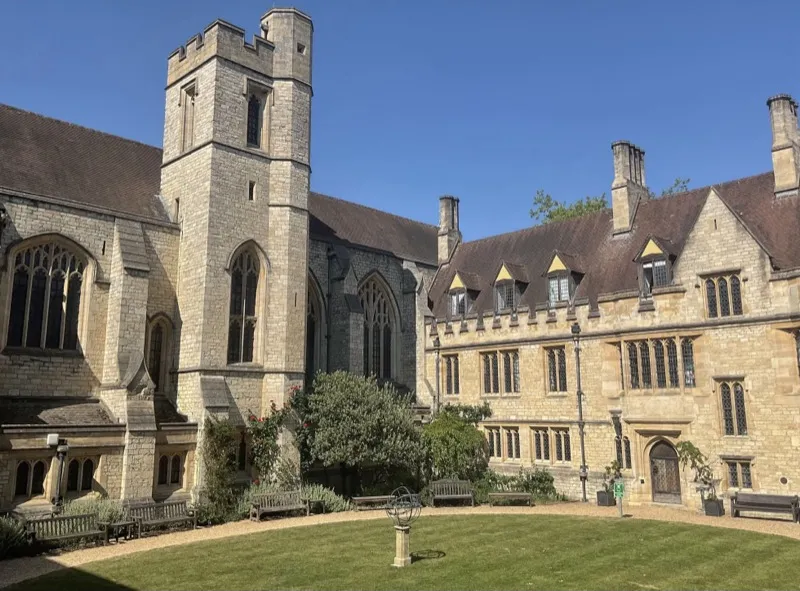
The gardens were restored and reshaped again after the Second World War, and the present layout dates from then. They are now divided into the Warden's Garden, the Fellows' Private Garden, the Fellows' Garden, the Cloister Garden (originally the cemetery), and the White Scented Garden.
The corners are full of survivals. An eighteenth-century cowshed is set into the remnants of the Royalist earthworks of 1642 — Oxford's defences when the city was the Royalist capital during the Civil War. One of the second-generation Sheldonian Emperor's Heads — the herms that lined Wren's theatre from 1868 to around 1970, before being pulled down and replaced — stands in the gardens. A sculpture of Maurice Bowra, Warden 1938-1970, is set among the lawns.
Visiting
Public access is at the college's discretion: Wadham admits visitors through the lodge on Parks Road during published opening hours, with hours varying in term and around college events. The gardens pair well with Worcester College gardens for a longer day on Oxford's most-walked college grounds, or with the Sheldonian Theatre for the rest of the Emperor's Head story.
Nearby
Within a few minutes' walk