St Barnabas Church, Jericho
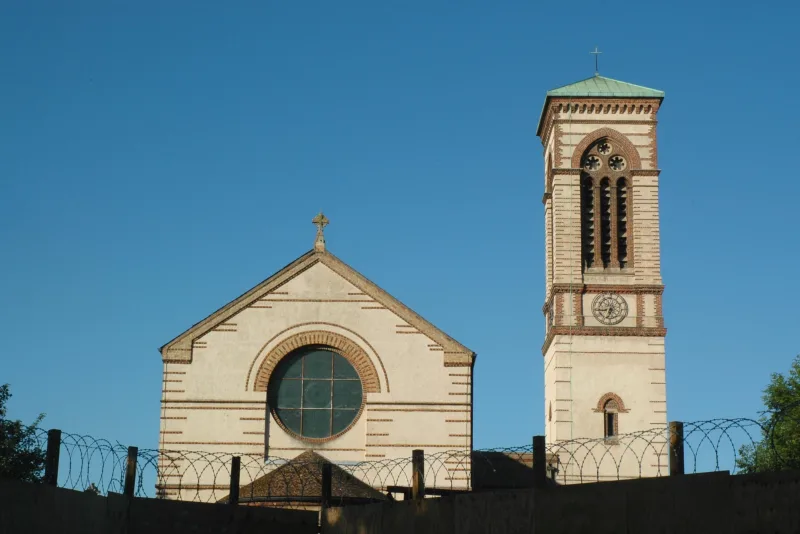
Jericho's Romanesque basilica — informally known as the 'Oxford Basilica' — built in 1869 by Sir Arthur Blomfield for Thomas Combe of OUP, modelled on San Clemente in Rome and the Ravenna basilicas, with an Italianate campanile visible across the canal.
Open daily 9am to 6pm. The campanile reads from a long way off across Port Meadow and the canal; the interior is the surprise — a Romanesque basilica in Jericho rather than the Gothic Revival you’d expect from the date. The ring of bells is tubular, not the usual cast bronze, and they sound the hours and quarters.
St Barnabas is a Church of England parish church in Jericho, close to the Oxford Canal, informally known as the Oxford Basilica. It is open daily from 9am to 6pm.
A basilica in Jericho
The church was founded by Thomas Combe (1796 to 1872), Superintendent of the Oxford University Press just up the road, and his wife Martha (1806 to 1893). The Combes were supporters of the Oxford Movement and the church was built to minister to the working population of the expanding Victorian suburb. The parish was formed from that of St Paul, Oxford in 1869.
The architect was Sir Arthur Blomfield, son of the Bishop of London, who had previously designed the chapel of the Radcliffe Infirmary. The architectural style is Romanesque basilica — deliberately not the Gothic Revival of the day — modelled on San Clemente in Rome, San Francesco and Sant'Apollinare Nuovo in Ravenna, and Santa Maria Assunta in Torcello. The Italianate campanile, visible from the surrounding area, was completed in 1872, three years after the church was consecrated by Bishop Wilberforce of Oxford in 1869.
Anglo-Catholic tradition and literature
The church maintains the Anglo-Catholic tradition of its foundation. It features across a wide range of literature from Thomas Hardy through P. D. James, and John Betjeman wrote a poem about it.
Bells
The church has a ring of ten distinctive tubular bells, on which the hours and quarters are sounded — unusual in Oxford, where most rings are cast bronze.
Nearby
Within a few minutes' walk