94 Woodstock Road (Dorothy Hodgkin's house)
The North Oxford house bearing the plaque to Dorothy Crowfoot Hodgkin — Somerville chemist, X-ray crystallographer, and the only British woman scientist to have been awarded a Nobel Prize.
A plaque on 94 Woodstock Road, a North Oxford villa a few minutes north of Somerville College, commemorates Dorothy Crowfoot Hodgkin — the X-ray crystallographer who solved the molecular structures of penicillin, vitamin B12 and insulin, and won the 1964 Nobel Prize in Chemistry. She remains the only British woman scientist to have been awarded a Nobel Prize.
The plaque
Wikipedia notes that 94 Woodstock Road is one of "a variety of plaques commemorating places where she worked or lived"; the plaque uses the form Dorothy Crowfoot Hodgkin — the name she adopted in 1949, twelve years after her marriage, when she was persuaded to put her married name on a chapter she had contributed to The Chemistry of Penicillin. (Before that she had published as "Dorothy Crowfoot"; after, as "Dorothy Crowfoot Hodgkin".) Wikipedia does not specify the years she lived at this address.
Why Hodgkin matters in Oxford
Hodgkin came up to Somerville in 1928 to read chemistry. She took a first in 1932, completed a PhD at Newnham, Cambridge under John Desmond Bernal, and returned to Oxford in 1934 as a Somerville research fellow. In 1936 the college appointed her its first chemistry fellow and tutor — a post she held for forty-one years. One of her chemistry pupils in the 1940s was Margaret Roberts, later Margaret Thatcher, who hung a portrait of Hodgkin in her Downing Street office when she became Prime Minister, despite Hodgkin's life-long Labour Party allegiance.
Her three landmark structures were all worked on from Oxford. Penicillin she solved with Barbara Low and others in 1945, demonstrating that — contrary to the prevailing opinion of organic chemists — the molecule contained a β-lactam ring. Vitamin B12, first encountered in 1948, took until 1955–56 to publish; Lawrence Bragg said the achievement was "as significant as breaking the sound barrier", and it was for the B12 structure that Hodgkin won the Nobel. Insulin took longest of all. She had been given her first sample of crystalline insulin in 1934 by Robert Robinson; the technique was not yet equal to the molecule. The structure was finally solved with a team of young international scientists in 1969 — thirty-five years after the first crystal photograph.
She was elected FRS in 1947, appointed to the Order of Merit in 1965 (only the second woman to hold it, after Florence Nightingale), and in 1976 became the first woman to receive the Copley Medal. In 2022 the Oxford Department of Biochemistry renamed its building the Dorothy Crowfoot Hodgkin Building.
Visiting
94 Woodstock Road is a residential house in North Oxford, on the west side of the road, a short walk north of the Radcliffe Observatory Quarter. View the plaque from the pavement and respect the residents; the house is not open to the public.
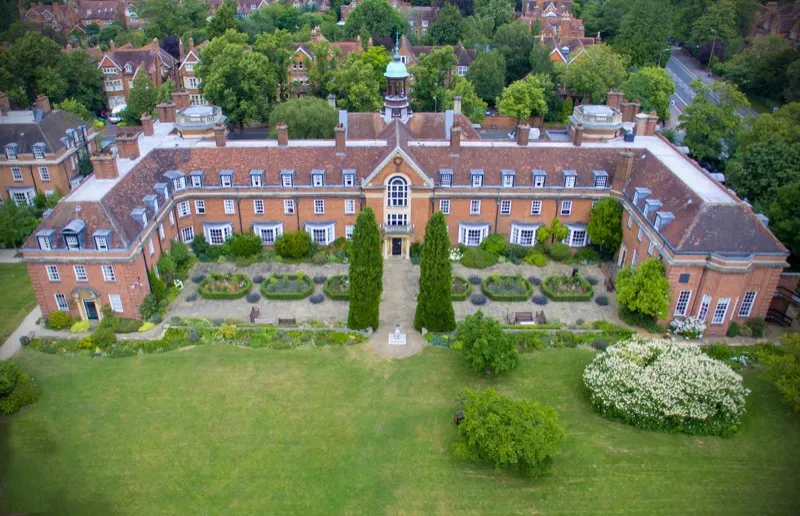
For Hodgkin in Oxford, Somerville College is the central place — she spent forty-one years there as fellow and tutor, and is commemorated within the college by the Dorothy Hodgkin Quarter. The Department of Biochemistry's Dorothy Crowfoot Hodgkin Building, on South Parks Road, is the largest physical memorial to her work in the city.
Nearby
Within a few minutes' walk