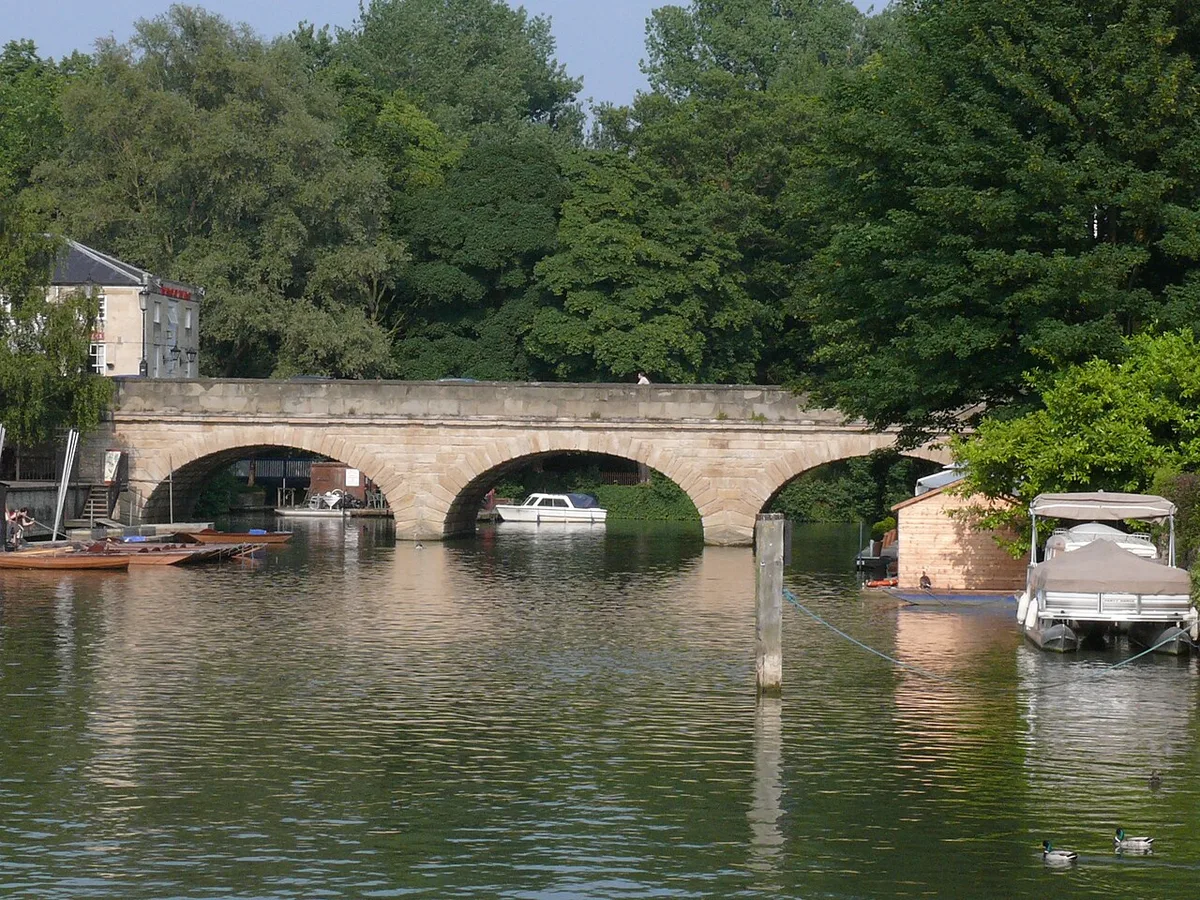
Folly Bridge
The 1825 stone bridge at the south end of St Aldate's, Grade I listed and standing on the site of an oxen-ford that gave Oxford its name. The boat that became *Alice in Wonderland* set off from here on 4 July 1862.
The bridge is best seen from the towpath. Walk down St Aldate’s past Christ Church and out beyond Christ Church Meadow; the bridge appears as you cross over the Thames. For the Carroll/Liddell association, the launch point is on the city side, where Salters Steamers and the punts still moor up. Look for the castellated house on the small island in mid-river — that is 5 Folly Bridge, and it has a history of its own. The Head of the River sits at the northeast corner of the bridge with a terrace over the water.
The bridge in front of you is dated 1825-27 — the work of an obscure London architect called Ebenezer Perry — but the crossing it sits on is older than Oxford. Cattle were forded across the Isis here long before there was a town to drive them to. Robert d'Oilli, the Norman castle-builder, put the first known stone bridge on the spot in around 1085. Until the late 17th century the structure was called South Bridge, the southernmost section of a long causeway called Grandpont, which carried the road from Oxford out across the river marshes towards Abingdon. By the 14th century the structure was "so dangerous as to be well nigh impassable", and over the centuries that followed it was patched, weighed down with toll booths, and finally pulled down and rebuilt in the form you see today. It is now Grade I listed.
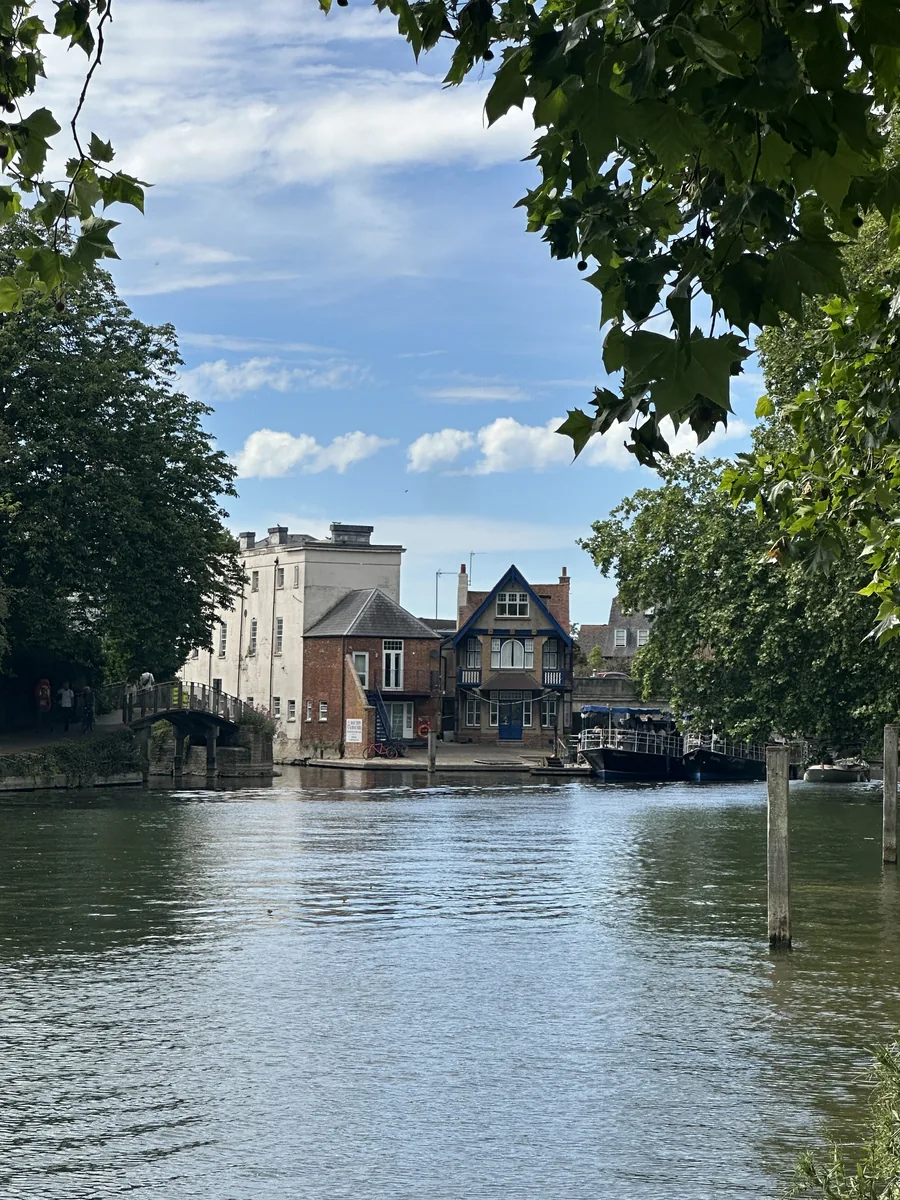 Folly Bridge from the river — Ebenezer Perry's 1825-27 arches. Photo: OxfordLocal.
Friar Bacon's Study
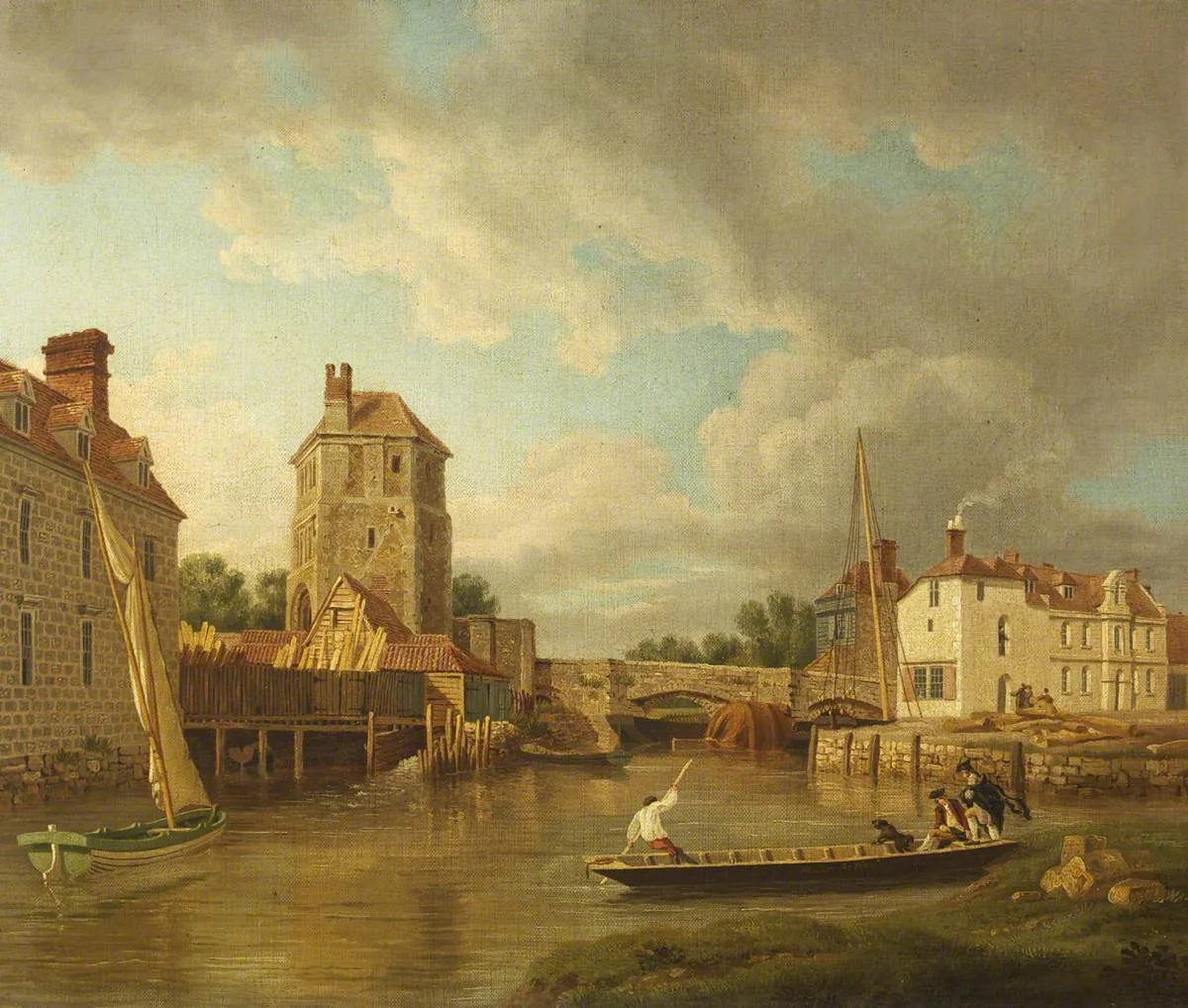
For five centuries, the building that drew visitors here was not the bridge itself but the gatehouse at its north end. In the 13th century the Franciscan friar and alchemist Roger Bacon — Doctor Mirabilis — was said to have lived and worked in a study built across the road there. Whether or not Bacon really observed the heavens from its roof, by Samuel Pepys's day the building was a tourist attraction. Pepys came in 1669 and recorded the visit with characteristic brevity: "So to Friar Bacon's study: I up and saw it, and gave the man 1s." The building was finally pulled down in 1779 to widen the road for stagecoaches, but not before the twelve-year-old J. M. W. Turner, on a holiday visit, made a careful drawing of "Bacon's Tower" looming over the bridge — one of the earliest surviving Turners.
The boat trip
The other great Folly Bridge story belongs to Christ Church. On 4 July 1862 — what Carroll's poem in the front of the book calls the "golden afternoon", though weather records for Oxford that day note it was "cool and rather wet" — the Christ Church mathematics tutor Charles Lutwidge Dodgson and his colleague the Reverend Robinson Duckworth rowed up the Isis from this bridge with the three Liddell sisters: Lorina (13), Alice (10) and Edith. The boat went five miles upstream to Godstow Abbey. To fill the journey, Dodgson improvised a story about a girl called Alice who fell down a rabbit hole. Alice Liddell asked him to write it down. He did, in a manuscript he titled Alice's Adventures Under Ground; three years later, expanded and rewritten, it appeared as Alice's Adventures in Wonderland. Salters Steamers, which still operates pleasure cruises from a yard immediately upstream, will take you up to Godstow under steam rather than oars.
Around the bridge
The toll-booth arrangement that once gated the entrance is gone. The toll house was rebuilt in 1844 and survives, Grade II listed; the tolls themselves were abolished in 1850. On the small island in mid-river, look for the unusual castellated house with cast-iron balconies and statues set into its outside walls. This is 5 Folly Bridge, bought in 1911 by the historian of science Robert Gunther. Punts and rowboats are available from the punt yard on the city side, just downstream from where Christ Church Meadow ends. From the bridge itself, the view downstream along the Thames Path towards Iffley is one of the loveliest in central Oxford — and entirely free.
Visiting
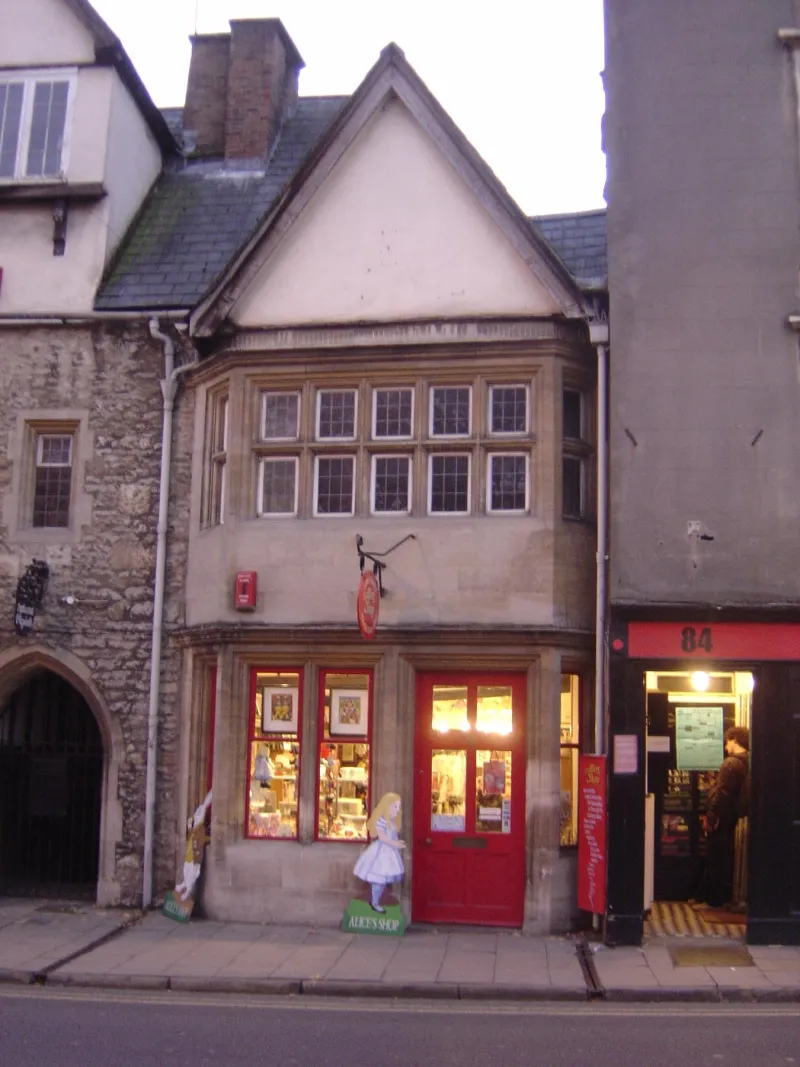
The bridge is on the public road; you can walk across it at any time. For a clearer view, drop down to the towpath on the south side and look back at the toll house and the castellated island. For the Alice connection, stand on the city-side approach and look up the river: the route taken on 4 July 1862, all the way to Godstow Abbey, runs north-west from the bridge through Christ Church Meadow's edge and out into Port Meadow. Pair this stop with a walk to Christ Church and Alice's Shop for a Carroll/Alice trail, or carry on south along the towpath to Iffley.
Nearby
Within a few minutes' walk