Swindlestock Tavern (site)
On 10 February 1355 two students complained about the wine at the Swindlestock Tavern at Carfax. Three days later, ninety-three people were dead — and the university had supremacy over the town for the next 470 years.
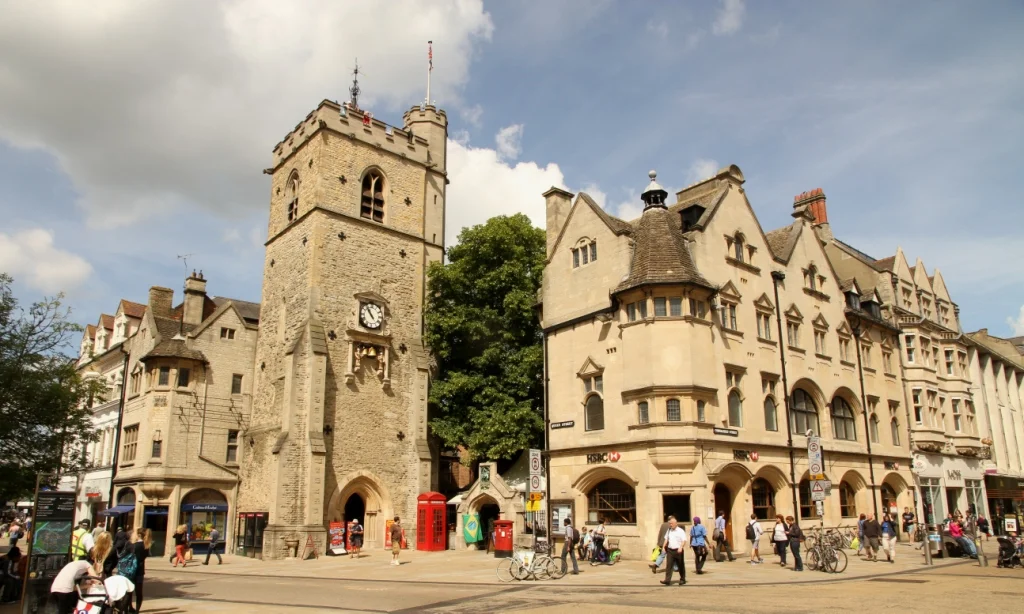
The plaque is set into the south wall of the bank that now occupies the corner of Queen Street and St Aldate’s. Easy to miss from the pavement; circle round to read it. Pair this stop with a climb up Carfax Tower and a look at the University Church of St Mary the Virgin on the High Street, where the annual penance Mass was held until 1825.
A cheap-wine complaint at a tavern on Carfax. Three days later most of north Oxford was on fire, sixty-three students were dead, the mayor was on his way to the Marshalsea, and the king was drafting a charter that would put the University of Oxford in legal command of its own town for the next 470 years.
The riot
On the morning of 10 February 1355 — the feast day of St Scholastica — two beneficed clerics-turned-students, Walter de Spryngeheuse and Roger de Chesterfield, were drinking at the Swindlestock Tavern at the corner of St Aldate's and Queen Street. Carfax in those days was the dead centre of medieval Oxford, the four streets meeting at a junction the records called Quatrevoies. The wine was bad. The students said so. The vintner, John de Croydon, did not appreciate the criticism. De Chesterfield threw his drink in de Croydon's face — and according to the more partisan town accounts, broke a wooden quart pot over his head while he was at it.
The brawl spilled out into Carfax. Within half an hour it was a riot. The locals rang the bell at St Martin's, the parish church on the corner of the junction (whose surviving tower is now Carfax Tower). The students rang the bells at the University Church of St Mary the Virgin on the High Street. Both sides went home and armed themselves. The chancellor of the university tried to calm things down and was shot at with arrows.
The next day, 11 February, eighty townsmen with bows tracked down a group of students at St Giles' church and chased them, killing at least one, all the way to the Augustinian priory on the north edge of the town. By evening, two thousand armed men from the surrounding countryside had marched in through the western gate under a black banner. The students barricaded themselves in their halls. The townsmen broke the doors down. There were reports of scholars being scalped, possibly in mockery of their clerical tonsures; corpses were thrown into privies, dunghills, gutters, and the Thames.
By the evening of the third day the violence was over. Around twenty townspeople were dead and as many as sixty-three members of the university. Most of the student halls had been plundered or burnt — except Merton, whose students were known for their quietness.
The settlement
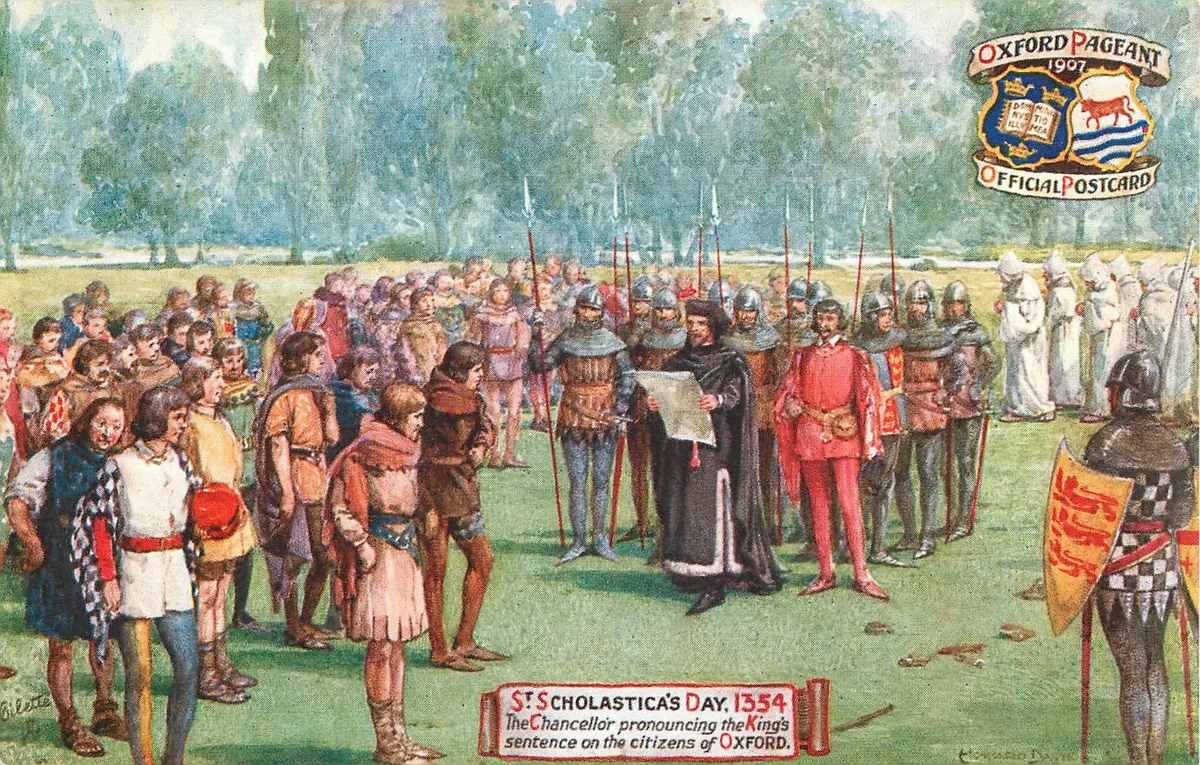
Both sides surrendered their corporate rights to the king. Edward III sent judges with commissions of oyer and terminer, then took four days to rule decisively for the university. The town was fined 500 marks. The mayor and bailiffs were sent to the Marshalsea prison in London. The Bishop of Lincoln, John Gynwell, placed an interdict on the town that lasted over a year — no Masses, no marriages, no burials, only baptisms of the very young.
On 27 June 1355 Edward issued the royal charter that mattered. It gave the chancellor of the university the right to tax bread and drink sold in the town, to assay weights and measures, to override the town's authorities in any legal matter involving a member of the university. The historian C.H. Lawrence calls it "the climax of a long series of royal privileges which raised the university from the status of a protected resident to that of the dominant power in the city" — a position unique among medieval European universities.
The penance was the strangest part. Each year, on St Scholastica's Day, the mayor, bailiffs, and sixty townspeople had to attend a Mass at the University Church for those killed in the riot, and pay the university one penny for every dead scholar. New mayors swore on oath to uphold the university's rights. The ritual continued for 470 years, until 1825, when the mayor refused to take part and the practice was quietly allowed to lapse.
In 1955, on the 600th anniversary, the city's mayor was given an honorary degree by the university and the vice-chancellor was made an honorary freeman of the city. It took six centuries to get even.
Visiting
The tavern site is at the corner of Queen Street and St Aldate's at Carfax, on the pavement opposite Carfax Tower. The bank that occupies the building now has a plaque set into its south wall recording the event. There is nothing else to see — but standing at the spot, with traffic streaming through where the riot started, is its own kind of history. Climb the tower for the view, then walk up to St Mary's on the High to picture six hundred years of mayors trooping in to apologise.
Nearby
Within a few minutes' walk