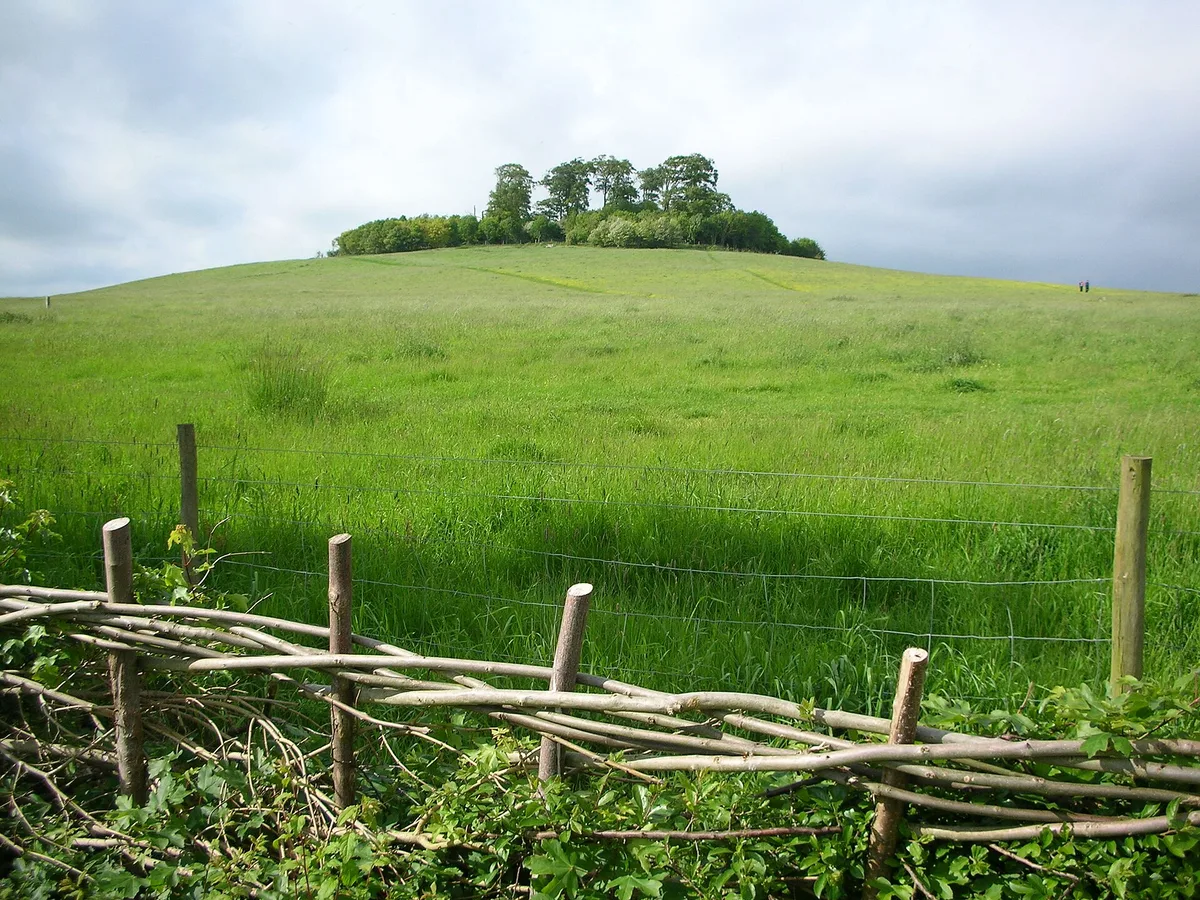
Wittenham Clumps
Two wooded chalk hills above the Thames Valley, the most visited outdoor site in Oxfordshire — Iron Age hillfort, Roman villa, beech plantings from the 1740s, and the view that haunted Paul Nash for thirty years.
The viewpoint guide on the north side of Round Hill orients the panorama. On a clear day, Faringdon Folly is visible 17 miles west, and Day’s Lock and Dorchester Abbey lie in the valley below.
The Wittenham Clumps are a pair of wooded chalk hills in the Thames Valley, in the civil parish of Little Wittenham — historically Berkshire, administered as part of South Oxfordshire since 1974. They are Oxfordshire's most visited outdoor site, drawing more than 200,000 people a year.
Form
There are two summits. Round Hill, the higher, reaches 390 feet (120 m); Castle Hill is 350 feet (110 m), about 350 metres south-east, and was the site of an Iron Age hillfort. A third hill, Brightwell Barrow, lies further south-east and is not normally counted among the Clumps. The wooded summits stand more than 70 metres above the surrounding fields, which is why the panoramic views are so unusually wide for this part of southern England.
The trees are the oldest beech tree plantings in England, dating to the 1740s. Strictly, "Wittenham Clumps" refers to those wooded summits — the hills themselves are properly the Sinodun Hills, from Celtic Seno-Dunum, "Old Fort". An alternative reading, sometimes offered, is that Sinodun is a scholarly pun on the Latin sinus — "bosom".
Archaeology
The summit of Castle Hill carries an Iron Age hillfort. The earliest earthworks are late Bronze Age; further banks and ditches were added in the early Iron Age. Excavation has shown that the inhabitants caught fish and wild boar, herded cattle and sheep, and grew barley and wheat. The fort was abandoned by the late Iron Age, and Romans were the next occupants of the site.
Channel 4's Time Team filmed at the Clumps in 2004, alongside Oxford Archaeology's excavation of Castle Hill. Over three days the team surveyed seven hectares using ground-penetrating radar, and revealed a Romano-British house with tessellated floors and painted wall plaster on the southern slope of Round Hill, plus an Iron Age cobbled floor with associated post holes. The overall chronology now reads: occupation from around 1000 BC; hillfort and surrounding farms from around 600 BC; the settlement shifting to the southern slopes around 300 BC; abandonment, then the Roman villa.
A 70 cm Late Iron Age sword and scabbard — the Wittenham Sword — was found in 1982, dating from 120 BC – AD 43. An oval bronze shield about 35 cm across was retrieved from the river Isis nearby in 1836.
In February 2021 archaeologists led by Chris Casswell of DigVentures announced the discovery of at least fifteen roundhouses dating from 400 to 100 BC, along with the remains of a Roman villa from the third to early fourth century CE, including kitchen utensils and an Iron Age "fridge" — a ceramic food-storage vessel set into a cool ground pit. In January 2024, the same team found an Iron Age workshop dating from between 770 and 515 BC, downslope from the hillfort.
Paul Nash
The painter Paul Nash first saw the Clumps in 1911 and described the view as "a beautiful legendary country haunted by old gods long forgotten". He returned to the subject again and again over the rest of his career, painting the wooded hills repeatedly through the First World War and after. The Clumps are one of the few specific English landscapes that became, for a major modern British painter, a lifelong motif.
The Poem Tree
On the eastern side of Castle Hill stood the Victorian "Poem Tree", a beech with a poem carved into its trunk by Joseph Tubb of Warborough Green in 1844–45. The tree died in the 1990s and finally collapsed in 2012. A stone now marks the 150th anniversary of the carving.
Folklore
There is a hollow on Sinodun Hill called the Money-Pit, supposedly the location of a treasure hoard guarded by a raven. Nearby is the Cuckoo Pen — local belief held that a cuckoo trapped within would ensure eternal summer. Both are folklore, attested locally rather than archaeologically.
In film and television
In 2007, Radiohead filmed a music video for "Faust Arp" at the Wittenham Clumps. The finale of the Black Mirror episode "Shut Up and Dance" was shot in the same spot, scored to Radiohead's "Exit Music (For a Film)".
Visiting
The site and its surroundings are managed as a nature reserve by the Earth Trust. Access is free, dawn to dusk, all year. A car park was added at Hill Farm in 1971; paths are open by foot year-round and the network is extensive enough to spend a half-day on. The Clumps pair well with Dorchester Abbey in the valley below, or with a longer prehistoric circuit taking in Wayland's Smithy, the Uffington White Horse, and the Devil's Quoits.