Oxford City Wall
The 13th-century defensive ring around medieval Oxford — best-preserved in the gardens of New College.
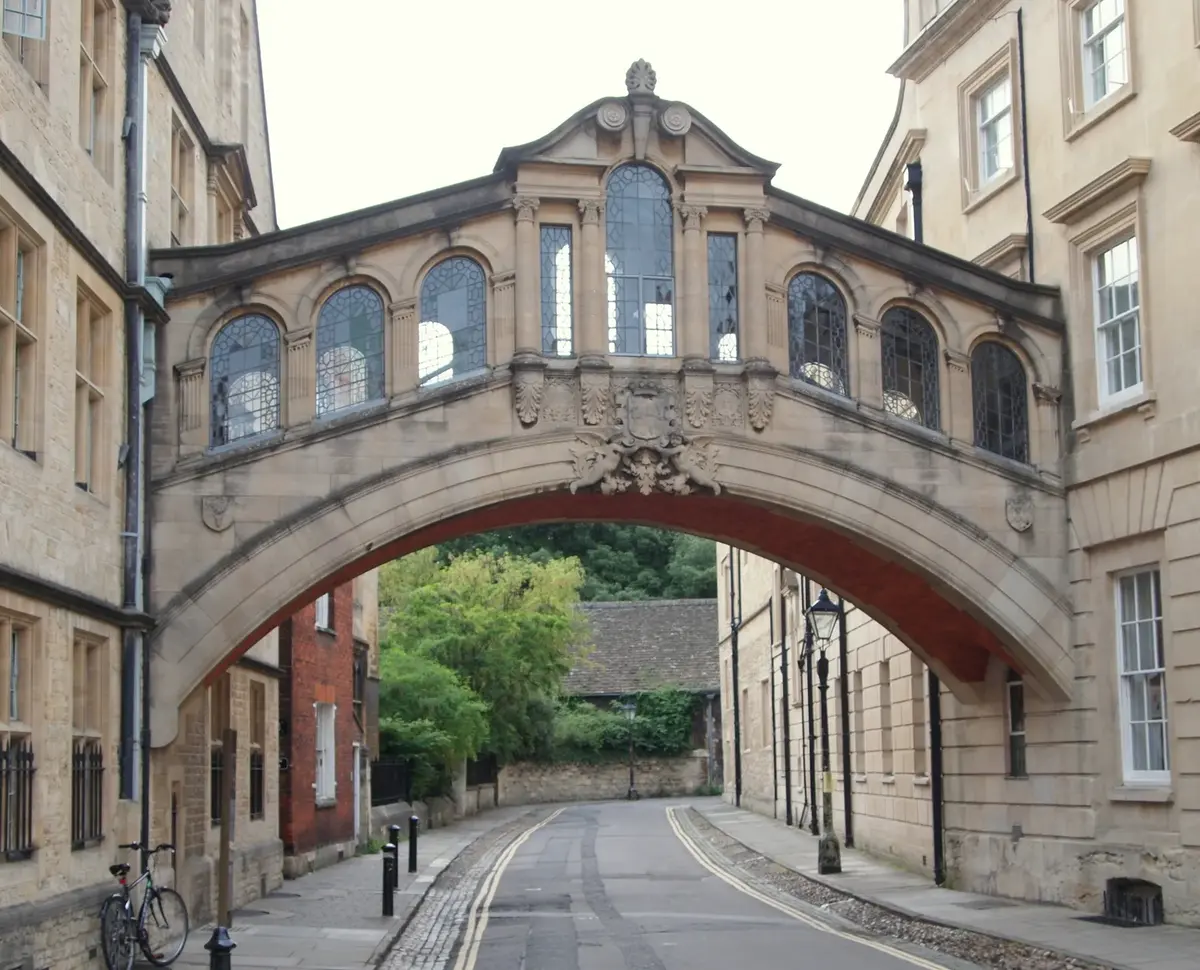
The most complete surviving stretch is inside New College, viewable on the college’s normal visiting hours. From New College Lane, take the small alley off the north side near the Bridge of Sighs — it runs past a low surviving section of the wall and brings you out at the Turf Tavern, otherwise almost impossible to find.
The Oxford city wall is what survives of the curtain defence that once ringed the medieval town. From 1226 onwards a roughly two-mile circuit of local rubble stone went up, enclosing about 120 acres. The wall was crenellated along its top and broken at intervals by more than twenty-five bastions, replacing a Saxon earthwork raised against the Viking raids of the ninth and tenth centuries. Today the surviving stretches carry scheduled-monument status, with twenty-seven individual sections separately listed at Grade I.
The route
Roughly rectangular in plan, the wall traced the southern flanks of George Street, Holywell Street and Broad Street along its northern edge. It then turned south behind New College, passed the Botanic Garden, and continued along the southern boundaries of Merton College and the great quadrangle of Christ Church before closing west along Castle Street to the castle itself. The four main gates — north, south, east and west — sat at the cardinal points, with toll roads from each meeting at Carfax in the centre.
The four gates
All four gates are gone, taken down at different points:
- South Gate was pulled down by Cardinal Wolsey in 1525 to clear the ground for his foundation of Cardinal College, which became Christ Church.
- West Gate followed in 1600.
- North Gate and East Gate were both demolished in 1772, as the wall fell out of use and the colleges absorbed its line into their gardens. The site of East Gate is now marked by the Eastgate Hotel on the High Street, at the head of Merton Street.
Where to see the wall today
The best-preserved sections are inside New College. Under a tradition established at the college's foundation in 1379, the college owns and must maintain these stretches, and submits to a triennial inspection of the walls by the Lord Mayor of Oxford and a delegation of councillors — a piece of medieval municipal theatre that still happens every three years.
Beyond New College, fragments survive at the back of several colleges and along garden walls. The Pevsner Architectural Guide describes the northern outer wall — the secondary outer ring built around the 1280s on the north-northeast side — as "unique among English medieval town defences" in its concentric design. Comparisons have been drawn with the concentric walling at the Tower of London, Dover Castle, and the late-13th-century Edwardian castles in North Wales.
How the wall was paid for
Funding came through a medieval system called murage — a tax on goods brought into the city. Around 210 households held what were known as "mural mansions": they carried a personal obligation to raise money for the wall in return for exemption from most other taxes and feudal duties, with the exception of military service.
The Civil War defences
When Charles I made Oxford his capital in 1642, the medieval circuit was in poor repair, and a fresh ring of earthen field defences on the ditch-and-rampart pattern was thrown up around it. To get the work done the king issued a labour decree: every man in the city between 16 and 60 had to give one day a week to the works, or hand over a shilling instead; refusal meant banishment from Oxford. The full layout of these Civil War earthworks survives on a plan drawn up by Bernard de Gomme, the king's military engineer.
Decline
In 1542 the town was granted city status. As Oxford expanded and the need for defence faded, the walls deteriorated, were demolished in places, and their bastions were converted into garden features for the university's colleges or inhabited as tenements. By the 18th century, much of the circuit had vanished into the urban fabric. Oxford's experience was unremarkable: of the roughly two hundred once-walled towns in England and Wales, only York and Conwy still held every one of their medieval gates by 1900. Statutory protection for the surviving Oxford remains was granted in the mid-1950s at the highest grade.
Frequently asked questions
Where can I see Oxford's city wall?
The best-preserved stretches are inside New College, visible on the college's normal visiting hours. There is also a short surviving fragment behind New College Lane near the Bridge of Sighs, reachable through a small unmarked alley that comes out at the Turf Tavern.
How old is Oxford's city wall?
The surviving stone circuit went up between 1226 and roughly 1240, on the line of an older Saxon earthwork — that earlier defence may date as far back as the ninth or tenth century, when it was raised in response to Viking raids.
Why are there no city gates left?
All four gates were demolished between 1525 and 1772, as Oxford expanded and the gates became impediments to traffic. South Gate went first (Wolsey, for Christ Church), then West Gate (1600), and North and East Gates together in 1772. The Eastgate Hotel marks the site of the East Gate at the head of Merton Street.
What is the "double wall" at Oxford?
A secondary outer wall was built around the 1280s on the city's exposed north-northeast side, parallel to and outside the main curtain. The Pevsner Architectural Guide describes it as "unique among English medieval town defences" — Oxford is the only English medieval town known to have had a concentric outer ring of this type.
Nearby
Within a few minutes' walk