Christ Church Meadow
A roughly triangular flood-meadow between the Thames and the Cherwell, owned by Christ Church and Grade I on the Register of Historic Parks and Gardens, with cattle, college boathouses and a path along the water.
The St Aldate’s gate leads onto Broad Walk through the War Memorial Garden. The Merton Street and Rose Lane entrances are quieter, and the path along the river runs on to the boathouses.
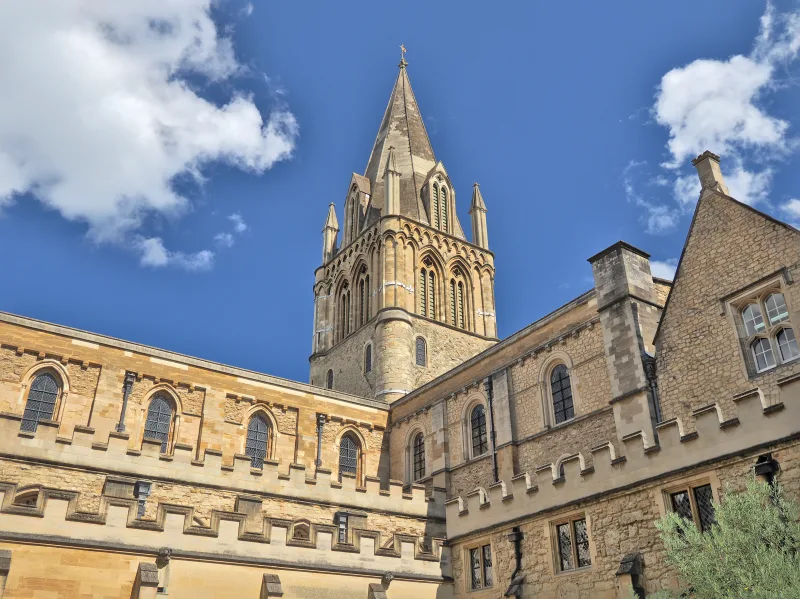
Christ Church Meadow is a flood-meadow in the south-east corner of the city centre, used for walking and picnics. It is roughly triangular, with the River Thames (here called the Isis) on one side, the River Cherwell on another and Christ Church on the third. The meadow belongs to the college and is listed Grade I on the Register of Historic Parks and Gardens.
Walking the meadow
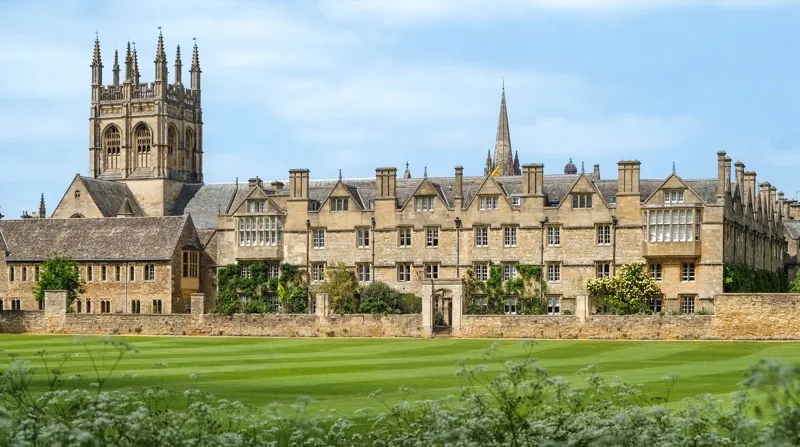
The lower ground by the Thames is grazed by cattle, Longhorns among them, and the upper ground holds sports fields. Broad Walk runs along the northern edge. Beyond it lie Merton Field and Merton College, with the tower of its chapel standing over the skyline. The college's medieval walls can be seen from the meadow.
The path along the river leads to the college boathouses, which stand on an island where the two rivers meet.
Getting in
The meadow is the college's private property, but the public may enter during the day, and access begins very early so that rowers can reach the boathouses. From the city centre the usual route is the gate off St Aldate's, and Broad Walk then crosses the Christ Church War Memorial Garden. Two more routes start at Merton Street, using Grove Walk and Merton Walk, and at the far end of the High Street, using Rose Lane beside the Botanic Garden. A less-used gate near The Head of the River and Folly Bridge joins Poplar Walk, which Henry Liddell created in 1872. All the entrances have railinged gates, locked at night.
Rowing
Eights Week and Torpids, the university's two main rowing events, are raced on the Thames beside the meadow, as is the Christ Church Regatta.
History
The Oxford Botanic Garden, founded in 1621, occupies the north-east corner of the meadow, on the bank of the Cherwell. In 1318 John Deydras, a pretender, claimed at the meadow that the devil had persuaded him to impersonate Edward II. James Sadler made a balloon ascent from here in the 18th century, and a plaque records it.
After the Second World War a relief road was planned across the meadow to join St Ebbe's. Vigorous opposition defeated the proposal in 1971.
Nearby
Folly Bridge is just downstream, and the Botanic Garden sits at the meadow's north-east corner.
Nearby
Within a few minutes' walk