Ashmolean Museum
Recommended
Museum
City Centre
The world's first university museum — free, with major collections of art and archaeology.
A short Regency terrace that Pevsner called 'the finest street ensemble of Oxford' — running from [Worcester College](/places/colleges/worcester/) at one end to the Ashmolean and the [Martyrs' Memorial](/places/landmarks/martyrs-memorial/) at the other, with the Oxford Playhouse and the Randolph Hotel along the way.
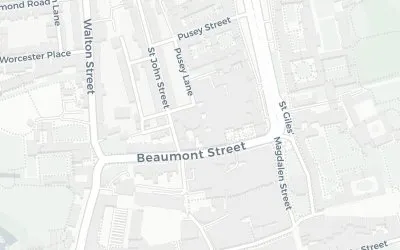
Beaumont Street runs east–west across the western edge of central Oxford, between the gardens of Worcester College at one end and the open junction with St Giles' at the other. It is a short street with an oversized reputation: laid out across the 1820s and built up with Regency terraces between 1828 and 1837, it was the first wholly planned street development in nineteenth-century Oxford. Nikolaus Pevsner called it "the finest street ensemble of Oxford" — and the verdict still tends to hold.
The ground that Beaumont Street now covers was previously the site of Beaumont Palace, a royal residence used by the Norman and Angevin kings of England. Two of Henry II's sons were born here: Richard I on 8 September 1157 and King John on 24 December 1166. A wall plaque at the western corner, where the terrace meets Walton Street, marks the site of the lost royal complex.
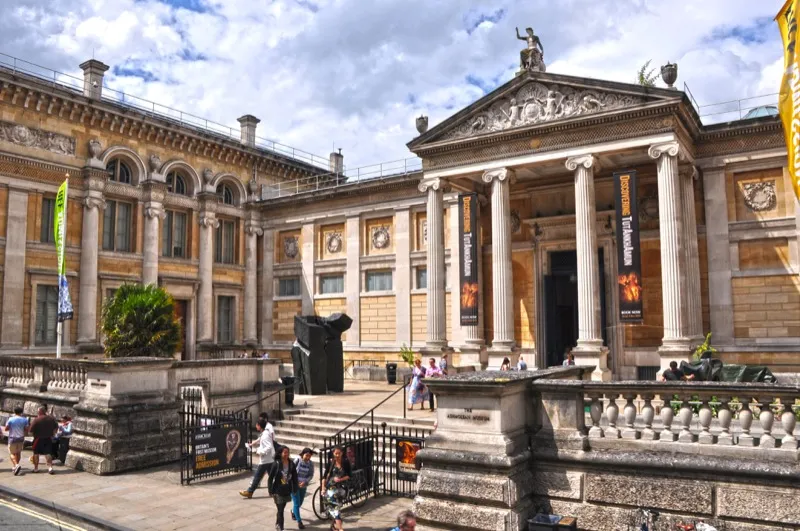
The most consequential building on Beaumont Street is at its eastern end: the Ashmolean Museum, occupying the whole northern corner where Beaumont meets St Giles'. Directly opposite the eastern end, in the middle of the road, sits the Martyrs' Memorial, a Victorian Gothic spire commemorating the Oxford burnings of Cranmer, Latimer and Ridley.
The south side of the eastern end is filled by the Randolph Hotel, built in 1864 to William Wilkinson's Victorian Gothic design and extended westward by J. Hopgood in 1952; it has stayed Oxford's grandest hotel for the century and a half since.
Set back on the south side, between the Randolph and Worcester, is the Oxford Playhouse — Sir Edward Maufe's restrained 1938 building, which has been the working home of university dramatic societies and visiting professional companies ever since. To the north, halfway along the terrace, St John Street breaks off into the Walton Street back-streets, an arrow-straight Regency mews of much the same date as Beaumont itself.
The original Regency houses on Beaumont Street were built as gentry residences, but by the late Victorian period most had been turned over to professional practice. The terrace today is heavily occupied by dentists and doctors' consulting rooms, in something close to a Harley-Street-of-Oxford pattern. At No. 36, the University's Institute of Archaeology — part of the School of Archaeology — has occupied a Regency house since the Institute's establishment in 1962.
Beaumont Street runs east–west in central Oxford, between the western entrance to Worcester College and the junction at St Giles' and Magdalen Street. The Ashmolean Museum stands at the eastern end on the north side; the Martyrs' Memorial is just across St Giles' from there.
Nikolaus Pevsner called Beaumont Street "the finest street ensemble of Oxford" because the terraces along both sides were built to a single Regency design between 1828 and 1837, giving the whole street a coherence that few other Oxford streets achieve. The view from the western end down to the Martyrs' Memorial frames the ensemble as Pevsner read it.
Beaumont Palace was a Norman and Angevin royal residence on the site that became Beaumont Street. Two of Henry II's sons — Richard I (born 1157) and King John (born 1166) — were born there. The palace was given away in the thirteenth century and gradually demolished; the surviving wall plaque at the western corner of the terrace marks where it stood.
Sources: Wikipedia: Beaumont Street · Wikidata: Beaumont Street (Q4877597) · OpenStreetMap: Beaumont Street, Oxford