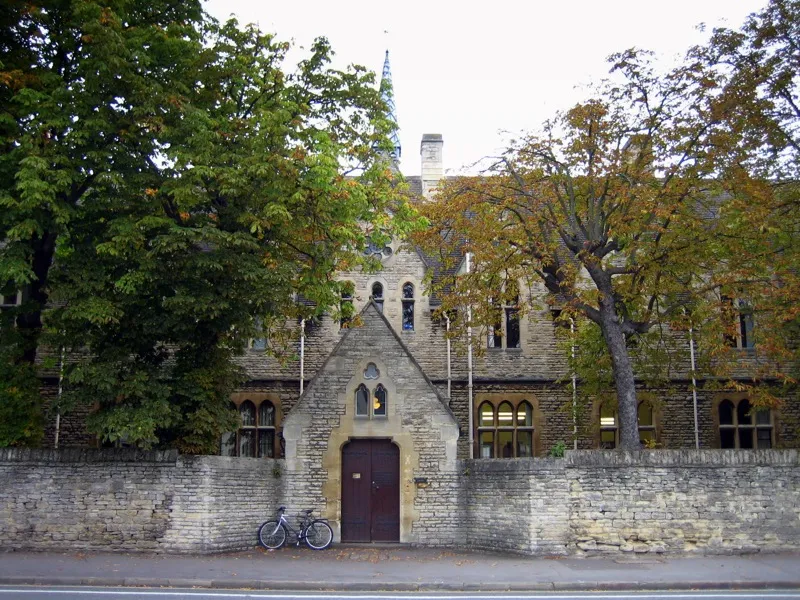
Wycliffe Hall
An evangelical Anglican hall on Banbury Road — third-oldest Anglican theological college in England
Wycliffe Hall is one of Oxford's evangelical Anglican Permanent Private Halls, set in a cluster of Victorian villas around the corner where Banbury Road meets Norham Gardens. The hall trains clergy and lay ministers for the Church of England and other Anglican churches, and it sits firmly within the evangelical wing of Anglicanism — taking in conservative, charismatic and open evangelical traditions. Its name comes from the medieval reformer and Bible translator John Wycliffe, who had been master of Balliol in the 1360s and is sometimes remembered as the "morning star of the Reformation."
Why it was founded
The hall is a late-Victorian foundation, set up at a moment of upheaval in Oxford religion. The university had only recently been opened to non-Anglicans by the Universities Tests Act of 1871, and an evangelical committee — among them J. C. Ryle, Robert Payne Smith and Edmund Knox — set about fundraising for a pair of new theological colleges, one in Cambridge and one in Oxford, that would train ordinands on what they called "a sound Evangelical and Protestant basis." The Oxford foundation took shape in 1877; its sister college Ridley Hall opened in Cambridge four years later. Wycliffe is the third-oldest Anglican theological college in England, and on its own count produces more sitting C of E bishops than any other such institution — twenty-one out of roughly 116 as of 2020.
The buildings
The hall stands at 54 Banbury Road, a substantial north Oxford villa designed by John Gibbs in 1866 for Tom Arnold the younger — a literary scholar and son of the headmaster of Rugby — and originally named "Laleham" after the family's former home in Middlesex. Arnold had hoped to take in private tutees but gave up the business after a decade, and the committee of evangelical churchmen bought the property in 1877 and renamed it Wycliffe Hall.
The house was extended in the 1880s by William Wilkinson and Harry Wilkinson Moore — a north wing of student rooms, a south wing housing the library — and a purpose-built dining hall was added on the Banbury Road side in 1913. In the gap between No. 54 and the adjacent No. 52 Banbury Road (a separate villa acquired in 1883, now Old Lodge and home to the library), a small chapel with a bellcote was built in 1896 to a design by George Wallace, with a stained-glass window depicting John Wycliffe. Over the twentieth century several other houses along Norham Gardens were added to the site, and their separate gardens were eventually amalgamated into the large green space that now sits behind the hall.
The hall today
The university relationship moved through several phases before Wycliffe became a Permanent Private Hall in 1996, under the principalship of Alister McGrath. Today the hall teaches a wide range of Oxford theology and philosophy programmes — from undergraduate certificates to doctoral work — and topped the Norrington Table (the unofficial league table of Oxford finalists' results) in both 2012 and 2017. Around sixty Church of England ordinands and sixty independent students study at the hall in a typical year, with another group of up to fifty visiting students through the SCIO programme, which Wycliffe runs in partnership with the Council for Christian Colleges and Universities. Almost all undergraduate places were phased out in the 2010s, and the hall now teaches mature students only.
Visitor info
Wycliffe is on the east side of Banbury Road, just north of the junction with Norham Gardens. It is a working theological college and not set up for casual visitors; the chapel and grounds are used by current members and on advertised occasions. Public events — lectures, ordinations and SCIO programme talks — are announced on the hall's website. The walk from the city centre takes about fifteen minutes from St Giles'; the site is opposite the University Parks entrance on Parks Road.
Frequently asked questions
What is Wycliffe Hall?
Wycliffe Hall is an evangelical Anglican PPH within Oxford, set up in 1877 to train clergy for the Church of England. It is named after John Wycliffe, the fourteenth-century master of Balliol who translated the Bible into English and is often described as the "morning star of the Reformation."
When did Wycliffe Hall become a Permanent Private Hall?
Wycliffe joined Oxford as a Permanent Private Hall in 1996, under the principalship of the theologian Alister McGrath. Before that, the hall trained students for ordination and validated theology degrees through other arrangements with the university.
Where is Wycliffe Hall in Oxford?
Wycliffe Hall is at 54 Banbury Road, in the Victorian suburb of north Oxford, near the junction with Norham Gardens and roughly opposite the University Parks. The main building is a Victorian villa designed in 1866 by John Gibbs; the chapel of 1896 sits between it and the adjacent house at No. 52.
Nearby
Within a few minutes' walk