University of Oxford — A Visitor's Guide
What it is, how to visit, and what's worth your time.
The University of Oxford isn't a campus. There's no front gate and no central quad — the university is the city, scattered across 43 colleges, two dozen libraries, four museums and a tangle of medieval lanes that students and visitors share. If you arrive looking for "the university", you'll spend an afternoon wondering where it starts.
This page exists to answer the questions people actually ask when they get here: what am I looking at, can I go in, and which bits are worth the time.
What it actually is
Teaching at Oxford goes back at least to 1096. It grew rapidly from 1167, when Henry II banned English students from studying at the University of Paris and they came home. A royal charter followed in 1248. After a violent row between students and townspeople in 1209, some scholars fled to Cambridge and founded the university there — which is why the two are so often paired.
Today Oxford is made up of 43 colleges — 36 independent chartered colleges, four permanent private halls run by religious foundations, and three societies controlled by the university itself. Every student belongs to one. Academic departments sit alongside the colleges, organised into four divisions: humanities, social sciences, medical sciences, and mathematical, physical & life sciences.
The Chancellor is Lord Hague of Richmond, inaugurated in 2025 — a ceremonial figurehead. Day-to-day running is the job of the Vice-Chancellor, currently Irene Tracey.
Can you visit?
Most colleges open their main quad to visitors for a few hours most days. A handful charge a small entrance fee; some open free; a few close completely during term-time exam periods (late April to mid-June). The university itself runs a few separate sites — the libraries and museums — which have their own hours.
Three things worth knowing before you go:
- Term time vs vacation. Colleges are noticeably stricter about access during the three eight-week terms (October, January, April). Vacations are easier, but quieter — less of the atmosphere people come for.
- Closures happen without warning. A college can shut its doors for a wedding, a degree ceremony or a film shoot. The signs go up that morning. Always check the college's own site the day you visit.
- Gardens and chapels are often free. Even where the college charges, an evensong service in the chapel is usually open to anyone.
Colleges worth seeing
The 43 colleges aren't equal. A few are extraordinary; most are pleasant but unremarkable. If you have a day, see these:
- Christ Church — the largest college, with the cathedral inside its walls and the Great Hall that was scanned into the Harry Potter films.
- Magdalen — the deer park, the cloisters, the meadow, and the Great Tower where the choir sings on May Morning.
- New College — fourteenth-century, with a chapel containing an El Greco and the longest unbroken stretch of Oxford's medieval city wall.
- Merton — home to Mob Quad, the oldest quadrangle in the university (built between 1288 and 1378).
- All Souls — no undergraduates, only fellows. The exam to get in is famously the hardest in the world. The North Quad façade is the one in every postcard.
- Trinity — broad lawns and a Christopher Wren chapel, opposite Blackwell's bookshop on Broad Street.
The full list of colleges is on a separate page if you want to plan further.
The buildings the university actually owns
A few iconic sites belong to the university rather than to individual colleges:
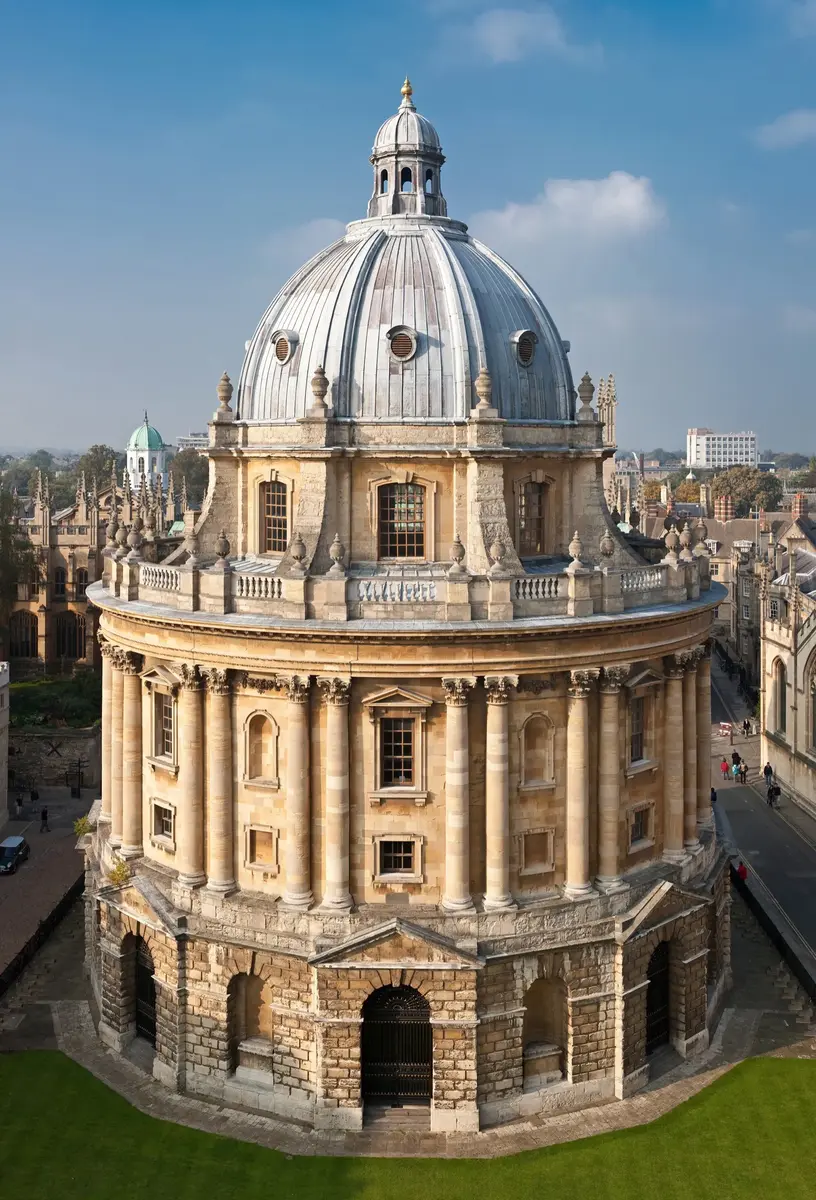
- The Radcliffe Camera — the round library you'll have seen in every photograph of Oxford. It's a working reading room of the Bodleian; outsiders can't go inside, but the square it stands in is the heart of the university.
- The Sheldonian Theatre — Christopher Wren's first major commission, built between 1664 and 1668. The university holds its degree ceremonies here. Open to visitors most days for a small fee.
- The Bodleian Library — founded by Sir Thomas Bodley in 1598 and opened in 1602. With over 11 million volumes it's the UK's second-largest library, after the British Library. Tours run several times daily and cover Duke Humfrey's reading room (where chunks of the Harry Potter films were shot).
- The Ashmolean — the world's oldest university museum, founded in 1683. Free. Allow at least two hours; the Egyptian and pre-Raphaelite collections alone could occupy a day.
- The University Church of St Mary the Virgin — used for university ceremonies before the Sheldonian was built. The tower offers the best paid view in Oxford.
- The Tower of the Five Orders — the gatehouse to the Old Schools Quadrangle, one of the most photographed corners of the city.
Traditions worth catching
Some of the university's customs are still going centuries later:
- May Morning — 6am on 1 May, the Magdalen College choir sings from the Great Tower as the sun rises. Thousands gather on Magdalen Bridge below.
- Encaenia — the university's grand ceremony in late June, when honorary degrees are awarded at the Sheldonian. The procession through Radcliffe Square is open to watch.
- Sub fusc — the academic dress (dark suit, white shirt, mortar board) worn for matriculation and exams. If you're in town in early October or in late spring you'll see swarms of students in it.
- The Rhodes Scholarship — one of the oldest international graduate scholarship programmes in the world, awarded annually since 1902. The Rhodes House on South Parks Road is open to the public on certain days.
Where students live and eat
Students live in college accommodation in their first year and often beyond, but those who move out tend to settle in one of three areas:
- Jericho — the closest neighbourhood to the city centre, full of Victorian terraces, independent cafés and the Phoenix Cinema. Heavily graduate.
- Cowley Road — the cheaper, livelier side of Oxford. Restaurants from every continent, pubs that don't close at 11, and the city's only independent music venues.
- Headington — further out, leafier, mixed with hospital staff and academics. Home to Headington Shark and a quieter pub scene.
What is the university not?
A medieval story about King Alfred founding the university in the 9th century turns up in tourist guides and on a handful of college websites. The 14th-century chronicler Ranulf Higden wrote it down. It is considered apocryphal. The earliest evidence of teaching in Oxford is from 1096 — impressive enough without needing Alfred.
Plan a half-day
If you're here for an afternoon and want a route that takes in the best of the university without rushing:
- Start at Carfax and walk east up the High Street.
- Stop at St Mary's — climb the tower for the view across the colleges.
- Cross into Radcliffe Square. Radcliffe Camera, the Bodleian, and the Sheldonian are all here.
- Book a Bodleian tour at the Weston Library shop, or walk through to the Bridge of Sighs on New College Lane.
- Continue down to Magdalen for the deer park and meadow walk.
- Finish with tea on the High Street — the Grand Café (84 High Street) stands on the site of Oxford's first coffeehouse, opened in 1650.
If you have longer, our architecture guide, literary guide and punting guide all pick up where this one leaves off.
Sources
- Wikipedia — University of Oxford: en.wikipedia.org/wiki/University_of_Oxford (checked 2026-05-16)
- Wikidata — Q34433 (University of Oxford)